Friday, February 22, 2013

Your Mental Sorbet: The 46th Academy Awards Streaker

Here is another "Mental Sorbet" that we could use to momentarily forget about those things that leave a bad taste in our mouths.


April 2, 1974
The 46th Academy Awards Streaker. While David Niven was introducing Elizabeth Taylor to present the award for Best Picture, a streaker named Robert Opel ran out from backstage, causing spontaneous laughter. David Niven tookcontrol of the situation by saying, “Isn't it fascinating to think that probably the only laugh that man will ever get in his life is by stripping off and showing his shortcomings?”


Stay Tuned

Tony Figueroa

Thursday, February 21, 2013

TV Confidential Archives: Week of Feb. 13-19, 2013

Show No. 173 with guests Linda Lawson, Michael Starr and Jan Creamer
Original Airdate: Week of Feb. 13-19, 2013
 
First hour: Michael Starr, television columnist for the New York Post and the author of such film and TV biographies as Hiding in Plain Sight: The Secret Life of Raymond Burr, discusses House of Cards, the second season of Dallas, and NBC’s plans to update Ironside as a vehicle for Blair Underwood. Also in this hour: Ed welcomes animal rights advocate Jan Creamer, co-founder of Animal Defenders International (ADI), an organization dedicated to protecting abused and neglected animals around the world. Plus: Greg Ehrbar on the release of The Joey Bishop Show on DVD. 

Second hour: Ed welcomes singer/actress Linda Lawson. Linda’s husband, the late John Foreman, co-produced Sometimes a Great Notion along with Paul Newman, while Newman also directed the motion picture. Linda shares some memories of working with Newman, Henry Fonda, Lee Remick, Richard Jaeckel and Oscar-winning costumer Edith Head. Also in this hour: An encore presentation of Phil Gries’ look back at “Meet Mr. Lincoln,” a short film about the life of Abraham Lincoln that originally aired on the NBC documentary series Project XX.

Wednesday, February 20, 2013

Fallen Angels and Sizzling Cold Cases: Next on TVC

Author, novelist and screenwriter Marvin J. Wolf will join us on the next edition of TV CONFIDENTIAL, airing Feb. 20-26 at the following times and venues:

WROM Radio
Detroit, MI
Wednesday 2/20
8pm ET, 5pm PT
2am ET, 11pm PT
Sunday 2/24
8pm ET, 5pm PT
2am ET, 11pm PT
Click on the Listen Live button at WROMRadio.net

Indiana Talks
Marion, IN
Wednesday 2/20
1pm ET, 10am PT
with replays at various times throughout the week
Click on the player at IndianaTalks.com

Share-a-Vision Radio
San Francisco Bay Area
Friday 2/22
7pm ET, 4pm PT
10pm ET, 7pm PT
Click on the Listen Live button at KSAV.org

Talktainment Radio
Columbus, OH
Thursday 2/21
2am ET, 11pm PT
Friday 2/22
3am ET, Midnight PT
Noon ET, 9am PT
Click on the Listen Live button at TalktainmentRadio.com

The Coyote KKYT 93.7 FM
Ridgecrest, CA
Sunday 2/24
9pm PT
Monday 2/25
Midnight ET
Click on the Listen Live button at Coyote395.com

The Radio Slot Network
San Francisco, CA
Monday 2/25
8pm ET, 5pm PT
Click on the Talk Slot button at RadioSlot.com

Passionate World Radio
Ann Arbor, MI
Tuesday 2/26
9:30pm ET, 6:30pm PT
Click on the Listen Now button at PWRTalk.com

We’ll welcome author, journalist and screenwriter Marvin J. Wolf. Marv’s books include Beating the Odds, the memoirs of ABC founding president Leonard Goldenson; The Tattooed Rabbi, the debut novel in the mystery series featuring crime-solving Rabbi Ben Maimon; and Fallen Angels: Chronicles of L.A. Crime and Mystery, a behind-the-scenes look at 39 famous crimes that not only took place in Los Angeles, but reveal an altogether different side of the City of Angels than what you may have seen on television or in the movies. Among the cases discussed in the book: Caryl Chessman, the Red Light Bandit; the precedent-setting rape trial of movie mogul Alexander Pantages; the death of actor Nick Adams; the tragic murder of actor Sal Mineo; and the gruesome murder of Elizabeth Short (the woman known as The Black Dahlia), an unsolved case that forever haunted “Jigsaw John” St. John, the famous L.A. police detective who wore Badge No. 1.

Marvin J. Wolf co-wrote Fallen Angels along with noted criminal defense attorney Katherine Mader; the book was recently re-released both in paperback and as an e-Book. The e-Book edition of Fallen Angels includes links to the various crime scenes detailed in each story, so that readers can travel directly to the locations themselves, virtually via Google Maps and Google Earth. Marv will join us in our first hour.

Then, while we’re on the subject of famous crimes and famous detectives in Los Angeles, 2013 marks the 30th anniversary of the premiere of Barnaby Jones, the long-running CBS private eye starring Buddy Ebsen. At the time of his death in 2005, Buddy Ebsen was working on Sizzling Cold Case: The Legend of Lori London, an original novel featuring Barnaby Jones. Though the manuscript was unfinished when Ebsen died, it was eventually completed and published in 2006 with the help of his friend, novelist Darlene Quinn. Darlene has since published several novels of her own, including Twisted Webs, Webs of Power, Webs of Fate and the forthcoming Unpredictable Webs.

We interviewed Darlene Quinn in November 2010 about working with Buddy Ebsen; we’ll replay that conversation as part of our second hour.

All this, plus a brand new edition of This Week in TV History. It’ll be a full program as always… we certainly hope you’ll join us.

TV CONFIDENTIAL: A radio talk show about television
Wed and Sun 8pm ET, 5pm PT on WROM Radio
Wed 1pm ET, 10am PT on IndianaTalks.com
Fri 7pm ET and PT on Share-a-Vision Radio, KSAV.org
Fri Noon ET, 9am PT on Talktainment Radio
Sun 9pm PT, Mon Midnight ET on The Coyote KKYT 93.7 FM (Ridgecrest, Calif.)
Mon 8pm ET, 5pm PT on The Radio Slot Network
Tue 9:30pm ET, 6:30pm PT on Passionate World Radio
Now also heard at various times throughout the week on IndianaTalks.com
Tape us now, listen to us later, using DAR.fm/tvconfidential
Also available as a podcast via iTunes, FeedBurner
and now on your mobile phone via www.stitcher.com/TVConfidential
Follow us online at www.tvconfidential.net
Follow us now on Twitter: Twitter.com/tvconfidential
Like our Fan Page at www.facebook.com/tvconfidential

Monday, February 18, 2013

This Week in Television History: February 2013 PART III

Listen to me on TV CONFIDENTIAL:
As always, the further we go back in Hollywood history, the more that fact and legend become intertwined. It's hard to say where the truth really lies.


February 22, 1963
Pebbles was born at the Bedrock Rockapedic Hospital.
The Flintstones Season 3 Episode 23 The Blessed Event
In 1963, when Hanna Barbera decided to add a baby to the show, their first choice was a boy. When Ideal Toy Company heard this, company executives approached Hanna Barbera with a proposal to change the baby character to a girl for which the toymaker could create a doll, and Hanna Barbera agreed.
 

February 25, 1928
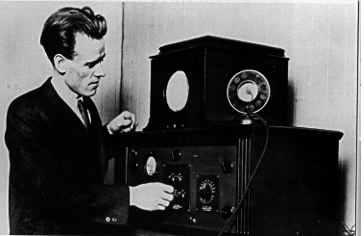
The Federal Radio Commission issues the first television license.  
The license went to the Charles Francis Jenkins Laboratories for a television broadcast station on Connecticut Avenue in Washington, D.C. The station later moved to Maryland and operated until 1932.
Government regulation of broadcasting has been in existence almost as long as the broadcast industry itself. The Wireless Act of 1910 required American ships to carry a broadcasting transmitter and qualified radio operator on all sea voyages. In the early 1920s, laws were passed governing transmission power, use of frequencies, station identification, and advertising. The Radio Act of 1927 shifted regulatory powers from the Department of Commerce to the new Federal Radio Commission, which became the Federal Communications Commission (FCC) in 1934.
Today, the FCC still regulates broadcasting and communications. The U.S. president appoints its five commissioners with the Senate's consent. The commission licenses and regulates radio and TV broadcasters as well as other communications mediums, such as telephone and cable television. It assigns frequencies and call signs to radio stations and is responsible for ensuring rapid, efficient telephone and telegraph service. The FCC also operates the Emergency Broadcast System, which provides a vehicle for authorities to communicate with the public and disseminate critical information immediately when national disaster strikes (though the system can also be used to broadcast weather warnings and local emergencies).
More expansive policy issues under the purview of the commission include deciding how much sex and violence is permissible on television. Deregulation of the industry in the 1980s reduced the FCC's size from seven to five commissioners and increased the term of radio and television station licenses. In the 1990s, the FCC developed a television rating system, much like the one used in movies, which helps people decide which shows are appropriate for the viewers in their household.


To quote the Bicentennial Minute, "And that's the way it was".

Stay Tuned

Tony Figueroa