I represent the first generation who, when we were born, the television was now a permanent fixture in our homes. When I was born people had breakfast with Barbara Walters, dinner with Walter Cronkite, and slept with Johnny Carson.
Read the full "Pre-ramble"
that we could use to momentarily forget about those
things that leave a bad taste in our mouths
The Puerto Rican debut of Tony Award-winning musical "Hamilton" happens today. It's part of an effort to raise money and awareness for the U.S. territory after Hurricane Maria devasted the island in 2017. Creator Lin-Manuel Miranda will play the role he developed, Alexander Hamilton. He brought the show to the island where his parents were born. David Begnaud offers a behind-the-scenes look at the production.
The
setting was the night shift of a Manhattan court, presided over by the
young, unorthodox Judge Harold T. "Harry" Stone (played by Harry Anderson).
It was created by comedy writer Reinhold Weege, who had previously
worked on Barney Miller in the 1970s and
early 1980s.
Anderson had developed a following with his
performances on Saturday Night Live
and made several successful appearances as con man "Harry the Hat" on
another NBC sitcom, Cheers. (For the first several years of its
run, Night Court aired on NBC Thursday nights after Cheers.) In
later seasons, while Anderson remained the key figure, John Larroquette
became the breakout personality, winning a number of awards and many fans for
his performance as the lecherous Dan Fielding.
The comedy style on Night Court changed as the
series progressed. During its initial seasons, the show was often compared to Barney Miller.
In addition to being created by a writer of that show, Night Court (like
Barney Miller) was set in New York City, featured quirky, often dry
humor, and dealt with a staff who tried to cope with a parade of eccentric,
often neurotic criminals and complainants. Furthering this comparison, these
characters were routinely played by character actors who had made frequent
guest appearances on Barney Miller, including Stanley Brock, Philip
Sterling, Peggy Pope, and Alex Henteloff.
But while the characters appearing in the courtroom (and the nature of their
transgressions) were often whimsical, bizarre or humorously inept, the show
initially took place in the 'real world'. In an early review of the show, Time
magazine called Night Court, with its emphasis on non-glamorous,
non-violent petty crime, the most realistic law show on the air.
Gradually, however, Night Court abandoned its
initial "real world" setting, and changed to what could best be
described as broad, almost slapstick comedy. Logic and realism
were frequently sidelined for more surreal humor, such as having the cartoon
character, Wile E. Coyote, as a defendant and
convicting him for harassment of the Road Runner with an admonition to find a
meal by some other means.
Pop
luminaries gather at the U.N. for the Music for UNICEF concert.
In an effort to call
attention to the poverty, malnutrition and lack of access to quality education
affecting millions of children throughout the developing world, the United
Nations proclaimed 1979 the "International Year of the Child." To
publicize the proclamation and raise money for UNICEF—the United Nation's
Children's Fund—plans were laid for a concert fundraiser featuring dozens of
leading lights of late-70s pop. Staged in the U.N. General Assembly Hall in New York City on January 9, 1979, the
show was subsequently broadcast around the world as "The Music for UNICEF
Concert: A Gift of Song."
The prime movers behind the Music for UNICEF concert
were the Bee Gees, their manager Robert Stigwood and the British television
host David Frost, of Frost-Nixon fame. The 1971 Concert for Bangladesh, which
raised millions for UNICEF through ticket sales and royalties from the concert
film and album, provided the template that the Bee Gees et al. planned to
follow, with an important, added twist. The organizers of the 1979 concert
asked all participating stars to donate to UNICEF the royalties from the song
they performed during the show. Another key difference between the two concerts
was a rather dramatic difference in musical esthetics. The Concert for
Bangladesh featured Ravi Shankar, George Harrison, Bob Dylan and Eric Clapton
performing songs like "Bangla Dun," "My Sweet Lord" and
"Blowin' in the Wind." The Music for UNICEF concert, on the other
hand, featured ABBA, Andy Gibb and Rod Stewart singing songs like
"Chiquita," "I Go for You" and, most improbably considering
the occasion, "Da Ya Think I'm Sexy?"
Suffice it to say that when
viewed with the benefit of hindsight, there is a very strong only-in-1979 vibe
about the Music for UNICEF concert: John Denver and Donna Summer on the same
stage; Henry Winkler (the Fonz) introducing Rod Stewart; and, most charmingly,
the late Gilda Radner introducing
"Benny-Bror-Goran-Andersson-Bjorn-Christian-Ulvaeus-Agnetha-Ase-Anna-Faltskog-Ulvaeus-Anni-Frida-Lyngstad.
Or to put it another way - ABBA!" It is not clear exactly how much money
the Music for UNICEF concert actually raised, or whether all of the
participating artists actually signed over all future royalties on the songs
they performed. At the very least, the Bee Gees' contribution to the effort,
"Too Much Heaven," would go on to be a #1 pop hit and raise more than
$7 million for the charitable programs of UNICEF.
January
9, 1984
Clara Peller was first seen by TV viewers in the
"Where's the Beef?" commercial campaign for Wendy's.
Peller's
"Where's the beef" line instantly became a catchphrase across
the United States. The diminutive octogenarian actress made the three-word
phrase a cultural phenomenon, and herself a cult star. At Wendy's, sales jumped
31% to $945 million in 1985 worldwide. Wendy's senior vice president
for communications, Denny Lynch, stated at the time that "with Clara we
accomplished as much in five weeks as we did in 14½ years." Former
Vice-President Walter Mondale also used the line against rival
Senator Gary
Hart in his bid for the Democratic nomination in the 1984 presidential campaign.
While
hugely popular, the advertising campaign proved to be short-lived, at least for
Wendy's. Peller had made actor scale wages – $317.40 per day – for the initial
Wendy's TV commercial of the campaign in January 1984. Her fee for
subsequent work as a Wendy's spokesperson was not disclosed, though Peller
admitted in an interview with People magazine
to having earned US$30,000 from the first two commercials and profits from
product tie-in sales. Wendy's later alleged that the company had paid Peller a
total of $500,000 for her work on the campaign, though Peller denied earning
that much.
Per
the terms of her Screen Actors Guild union contract, the
actress was free to participate in any commercials for products, goods or
services, which did not directly compete with Wendy's hamburgers. She
subsequently signed a contract with the Campbell Soup Company to appear in an
advertisement for PregoPasta Plus spaghetti sauce. In the Prego commercial,
Peller examines the Prego sauce and after wondering "Where's the
beef?" declares, "I found it! I really found it". However, after
the Prego commercial aired on television in 1985, Wendy's management decided to
terminate her contract, contending that the Prego commercial implies "that
Clara found the beef at somewhere other than Wendy's restaurants". In
announcing the dismissal, Wendy's Denny Lynch stated, "Clara can find the
beef only in one place, and that is Wendy's". Peller's response was
short and swift: "I've made them millions, and they don't appreciate
me."
Following
the conclusion of the "Where's the beef" campaign, Wendy's
Restaurants entered a two-year sales slump. Vice President Lynch later
admitted that consumer awareness of the Wendy's brand did not recover for
another five years, with the advent of a new, humorous line of TV commercials
featuring the brand's founder, Dave Thomas.
January 9, 1999
The first
episode of Providence aired on NBC. The show revolves around Dr. Sydney Hansen (played by Kanakaredes), who left
her glamorous job in Beverly Hills
as a plastic surgeon for the rich, so she could return to her hometown of Providence, Rhode
Island, and be with her family. Sydney lives with her
father Jim, brother Robbie, sister Joanie, and sister's baby Hannah in a large
home in suburban Providence that also houses her father's veterinary clinic.
Sydney's mother dies in the first episode but continued to appear to Sydney as
a spirit, and to offer advice.
The show ends rather abruptly, with a two-part wedding
episode. NBC called this Providence's "winter finale," fully
expecting to bring it back in the spring or autumn of 2003, but these plans
were eventually scrapped when some cast members, including Melina Kanakaredes,
opted out of producing a sixth season.
NBC links its East and Midwest TV networks,
celebrating with a special ceremonial telecast.
Radio network NBC had started experimenting with
television broadcasts as early as 1938 and began regular service in 1939,
starting with the World's Fair in New York. NBC and CBS both received
commercial licenses for stations in New York City on July 1, 1941. NBC launched
its first TV network in 1946 by transmitting programs from its New York station
to its Philadelphia and Schenectady stations. The company didn't open its
Midwest network until September of 1948. The West Coast was added in September
1951, creating the country's first coast-to-coast network.
January 11, 1979
Jack Soo Died. Soo was diagnosed with esophageal cancer during Barney
Miller's fifth season (1978–79). The cancer spread quickly, and Soo died on
January 11, 1979 at age 61. His last appearance on the show was in the episode
entitled "The Vandal," which aired on November 9, 1978.
Because his character (and Soo himself) was so
beloved, a special retrospective episode was made, showing clips of his best
moments, which aired at the end of the season. The most poignant moment of the
show came at the end, when the cast members raised their coffee cups in a final
farewell toast to the late actor.
Soo's last words to his Barney Miller co-star Hal Linden
before his death were: "It must have been the coffee."
January 12, 1949
Arthur Godfrey and His Friends was debuted on CBS-TV.
The show stayed on the network
for seven years.
The
hour-long series aired on CBS
Television from January 1949 to June 1957 (as The Arthur
Godfrey Show after September 1956), then again as a half-hour show
from September 1958 to April 1959.
The series was a hit in
the Nielsen ratings in the early to mid 1950s,
often finishing just behind Arthur Godfrey's Talent Scouts. It
ranked #18 in the 1950-1951 season, #6 in 1951-1952, #3 in 1952-1953, #6 in
1953-1954 and #22 in 1954-1955. Arthur Godfrey and His Friends also
earned a nomination for an Emmy Award in
1953 for Best Variety Program.
January 12, 1949
Kukla, Fran and Ollie, the Chicago-based children’s show, made its national
debut on NBC-TV.
Burr Tillstrom was the creator and only puppeteer on the show, which premiered as the hour-long Junior Jamboree locally on WBKB in Chicago, Illinois, on October 13, 1947. The program was renamed Kukla, Fran and Ollie (KFO) and transferred to WNBQ (the predecessor of Chicago's WMAQ-TV) on November 29, 1948. The first NBC network broadcast of the show took place on January 12, 1949. It aired from 6–6:30 p.m. Central Time, Monday through Friday from Chicago.
Stewart Robert "Bob" Einstein November 20, 1942–January 2, 2019
Bob Einstein's parents were the comic Harry Einstein, best known for playing the character Parkyakarkus on radio and in the movies, and the actress-singer Thelma Leeds. His younger brother is comedian and writer Albert Brooks (born Albert Lawrence Einstein), and his older brother, Cliff Einstein, is a retired advertising executive in Los Angeles.
On the November 12, 2009, edition of TNA Impact!, he was the booker of the night. He made Super Dave's Spike Tacular, a four-episode sketch series on Spike TV reprising his Super Dave character, once again engaging in outrageous stunts.
Einstein appeared on the second season of Anger Management as Charlie Goodson's very angry neighbor, and his character in the show instantly got an unflattering nickname based on a feminine hygiene product.
Einstein has voiced two characters from The Life & Times of Tim, playing the Elephant Trainer in Tim & the Elephant in the second season, and the bookie in Pray for the Jets in the third.
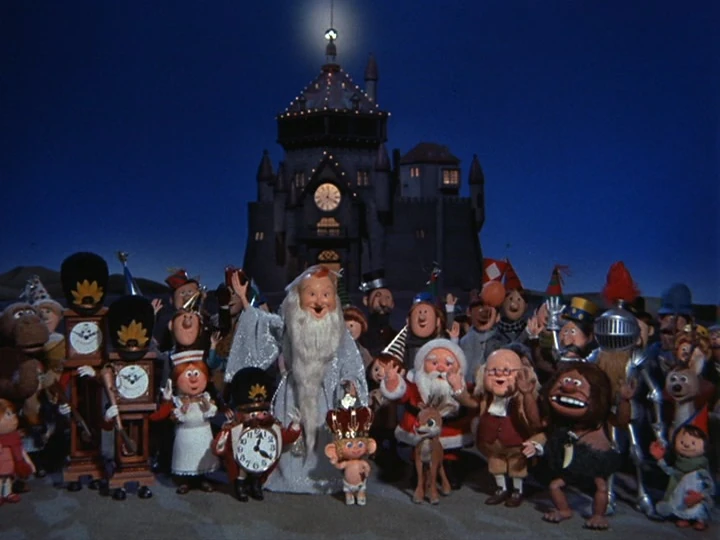
Rudolph has just come back from delivering Christmas presents with Santa Claus when he is asked by Father Time to find the missing Baby New Yearbefore midnight on New Year's Eve. The baby, named Happy, ran away because everyone laughed at his large ears, although no one meant it in a cruel way.
Unless Happy is returned before December 31 to take his position as the new year, the current year will not end and the date will perpetually remain December 31 forever. If this happens, the evil buzzard named Aeon will rule the world forever.





:format(webp)/cdn.vox-cdn.com/uploads/chorus_image/image/57978107/90830947.jpg.0.jpg)