 |
We love doing the show for you, but what we really, really love is doing the show with you. -Stephen Colbert |

Stay Tuned
Tony Figueroa

I represent the first generation who, when we were born, the television was now a permanent fixture in our homes. When I was born people had breakfast with Barbara Walters, dinner with Walter Cronkite, and slept with Johnny Carson. Read the full "Pre-ramble"
|
We love doing the show for you, but what we really, really love is doing the show with you. -Stephen Colbert |
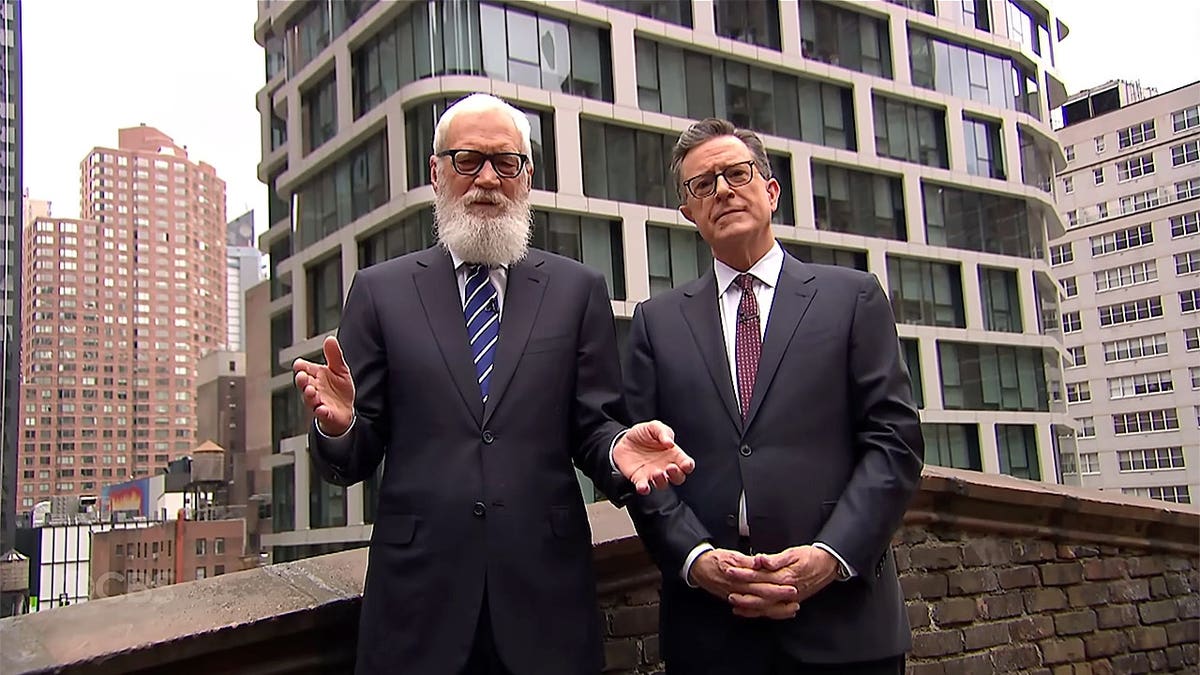 |
| Letterman: In the words of the great Ed Murrow, good night and good luck, motherf*ckers! |


May
8, 1976
The theme song from Welcome
Back, Kotter is the #1 song in America
What
Sebastian's sweet, wistful and playfully nostalgic tune did not do, however,
was influence the tone and content of the show. To listen to "Welcome
Back," you'd think that Welcome Back, Kotter was a seriocomic
slice-of-life program in the mold of, say, The Courtship of Eddie's Father—another
70s TV show with a theme song by a great 60s songwriter (Harry Nilsson).
Instead, Welcome Back, Kotter was little more than a flimsy platform for
catchphrase-spouting caricatures, albeit an insanely successful one. Arnold
Horshack's "Oooh, oooh, oooh," Freddie "Boom Boom"
Washington's "Hi therrre," Vinnie Barbarino's "What? What?"
and Gabe Kotter's "Up your nose with a rubber hose" were the
pop-cultural coin-of-the-realm in 1975-76, and though they bore little relation
in tone or spirit to the song that topped the charts on this day in 1976, the
disconnect did nothing to hinder the popularity of all things Kotter-related.
Indeed, if you weren't wearing an Uncle Sam or King Kong T-shirt in the summer
of America's bicentennial year, you were probably wearing one with a picture of
"the Sweathogs" and a colorful phrase like "Off my case, toilet
face" on it.
May 9, 1971
Last Honeymooners episode airs.
The last original
episode of the sitcom The Honeymooners, starring Jackie Gleason as
Brooklyn bus driver Ralph Kramden, airs.
Although a perennial rerun favorite in syndication, The Honeymooners
actually aired only 39 episodes in its familiar sitcom format, running for just
one season in 1955-56. The show debuted on October 5, 1951, as a six-minute
sketch on the variety show Cavalcade of Stars, hosted by Jackie Gleason.
Cavalcade of Stars evolved into The Jackie Gleason Show in 1952,
and Gleason continued the sketches, playing the blustery Ralph Kramden. Regular
cast member Audrey Meadows soon replaced the original casting choice, Pert
Kelton, as Ralph’s long-suffering wife, Alice, who deflated his get-rich-quick
schemes but often saved the day. Art Carney played Gleason’s friend and
sidekick, Ed Norton, from the beginning, and Joyce Randolph was the most
memorable incarnation of Ed’s wife, Trixie.
In 1955, Gleason had tired of the hour-long variety-show format and wanted
to try something new. He suggested creating two half-hour programs: The Honeymooners
and Stage Show, a musical-variety show, which Gleason would produce.
Among Stage Show’s many musical guests was the first-time TV performer
Elvis Presley, who visited the show in January 1956.
In a departure from most TV shows of the time, The Honeymooners was
filmed in front of a live audience and broadcast at a later date. To allow
Gleason more time to pursue other producing projects, he taped two episodes a
week, leaving him free for several months at the end of the season. Shows were
taped at New York’s Adelphi Theatre in front of around 1,000 people.
Unfortunately, the two shows did not appeal to audiences as much as Gleason
had hoped. He soon returned to his hour-long variety format, occasionally
including Honeymooners skits. He sold the full Honeymooners episodes
to CBS for $1.5 million, and they would go on to earn the network a windfall in
syndication. In 1966, Gleason began creating hour-long Honeymooners
episodes, which he aired in lieu of his usual variety format. From 1966 to
1970, about half of Gleason’s shows were these hour-long episodes. In 1971, the
episodes were rebroadcast as their own series, until May 9, 1971, when the
final episode aired.
Despite its brief life as a traditional sitcom, The Honeymooners remains
one of the most memorable TV comedies of all time, rivaled only by I Love
Lucy in its pioneering role in television history. Its influence has
stretched into modern-day sitcom classics such as Roseanne (also a show
focused on a working-class American family) and Seinfeld (another sitcom
about wacky New York neighbors). The devotion of Honeymooners fans
throughout the years has bordered on cultish worship, including the formation
of a club known as RALPH: Royal Association for the Longevity and Preservation
of the Honeymooners.
May 9, 1991
Michael Landon appeared on the Tonight Show and talked about condition with cancer.

April 27, 1986
Video pirate disrupts HBO signals.
A video pirate manages to override the satellite transmission of an HBO movie on this day in 1986. He interrupted the show with a message stating he did not intend to pay for his HBO service.April 29, 1961
ABC’s Wide World of Sports premiered.
Spanning the globe to bring you the constant variety of sport... the
thrill of victory... and the agony of defeat... the human drama of athletic
competition... This is ABC's Wide
The series' April 29, 1961 debut telecast featured both the Penn and Drake
Relays. Jim McKay (who hosted the program for most of its
history) and Jesse Abramson, the track
and field writer for the New York Herald Tribune, broadcast
from Franklin Field with Bob
Richards as the field
reporter. Jim Simpson called the action
from Drake Stadium with Bill
Flemming working the field.
During its initial season in the spring and summer of 1961, Wide
World of Sports was initially broadcast from 5:00 p.m. to
7:00 p.m. Eastern Time on Saturdays. Beginning in
1962, it was pushed to 5:00 to 6:30 p.m., and later to 4:30 to
6:00 p.m. Eastern Time to allow ABC affiliates in the Eastern and Central
Time Zonesto carry local early-evening newscasts.
In 1961, Wide World of Sports covered a bowling event
in which Roy Lown beat Pat Patterson. The
broadcast was so successful that in 1962, ABC Sports began covering the Professional Bowlers Tour.
In 1964, Wide World of Sports covered the Oklahoma Rattlesnake
Hunt championships; the following year, ABC premiered outdoor program The American Sportsman, which
remained on the network for nearly 20 years.
In 1973, the Superstars was first televised as a segment
on Wide World of Sports; the following year, the Superstars debuted
as a weekly winter series that lasted for 10 years.
In 1963, ABC Sports producers began selecting the Athlete
of the Year. Its first winner was track
and field star Jim Beatty for being the first to run a
sub-4-minute mile indoors. Through the years, this award was won by such now
legendary athletes of Muhammad Ali, Jim Ryun, Lance
Armstrong, Mario Andretti,Dennis
Conner, Wayne Gretzky, Carl Lewis and Tiger
Woods. The award was discontinued in 2001.
In later years, with the rise of cable
television offering more outlets for sports programming, Wide
World of Sports lost many of the events that had been staples of the
program for many years (many, although not all, of them ended up on ESPN, a sister network
to ABC for most of its existence). Ultimately, on January 3, 1998, Jim McKay
announced that Wide World of Sports, in its traditional anthology
series, had been cancelled after a 37-year run. The Wide World of
Sportsname remained in use afterward as an umbrella title for ABC's weekend
sports programming.
In August 2006, ABC Sports came under the oversight of ESPN, under the
relaunched banner name ESPN on ABC. The Wide World of Sports title
continues to occasionally be revived for Saturday afternoon sports programming
on ABC, most recently during the 140th Belmont Stakes as a tribute to Jim
McKay, following his death in June 2008. Most of ABC's sports programming
since Wide World of Sports ended as a program has been
displaced from ABC and moved to ESPN; the cable network began producing its own
anthology series on Saturday afternoons in 2010, ESPN Sports Saturday, which consists of
documentaries originally featured on ESPN's E:60 and 30 for 30 programs,
and a modified version of the ESPN interactive series SportsNation, titled Winners
Bracket.
May 1, 1931
President
Herbert Hoover officially dedicates New York City's Empire State Building. Less than eight months later, a
television-transmitting antenna had been erected atop the structure (The top
was originally designed as a mooring mast for dirigibles). During the ensuing
36 years, television and FM radio signals have continued to be transmitted from
this location. Today, 22 stations share the site.
May 2, 1941
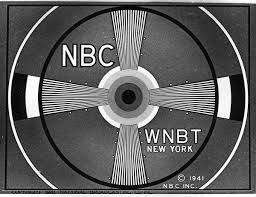
May 2, 1996
May 3, 1991
Prime-time soap opera Dallas airs its last
episode. The episode was watched by
33.3 million viewers (38% of all viewers in that time slot)
In 2010, cable network TNT announced they had ordered
a pilot for the continuation of the Dallas series. After viewing the completed
pilot episode, TNT proceeded to order a full season of 10 episodes.
The new series premiered on June 13, 2012, centering
primarily around John Ross and Christopher Ewing, the now-grown sons of J.R.
and Bobby. Larry Hagman, Patrick Duffy and Linda Gray returned in full-time
capacity, reprising their original roles. The series is produced by Warner
Horizon Television, a subsidiary of Warner Bros., which holds the rights to the
Dallas franchise through its acquisition of Lorimar Television and is a sister
company to TNT, both under the ownership of TimeWarner.
The new series is a continuation of the old series,
with the story continuing after a 20-year break. It does not take the events of
the TV movies Dallas: J.R. Returns or Dallas: War of the Ewings as canon.
Instead we find the characters as they are today, 20 years after the events of
the Season 14 cliffhanger.[29] In an interview with UltimateDallas.com, Cynthia
Cidre was asked to describe the new Dallas. She responded, "I tried to be
really, really respectful of the original Dallas because it was really clear to
me that the people who love Dallas are [like] Trekkies, really committed to
that show and I really did not understand that before, so I never wanted to
violate anything that had happened in the past. On the other hand that was the
past, twenty years had gone by, so at the same time I think we're properly
balanced between the characters of Bobby Ewing, J.R. and Sue Ellen. I also have
the new cast and it's John Ross and Christopher, the children of Bobby and
J.R., and their love interests. Total respect and a balance of old and
new."


October 28, 1950
Popular radio personality Jack Benny moves to
television with The Jack Benny Program. The TV version of the show ran for the next 15 years.
Benny's success in
vaudeville soon won him attention from Hollywood, where he made his film debut
in Hollywood Revue of 1929. Over the years, he won larger roles, notably
in Charley's Aunt (1941) and To Be or Not to Be (1942). Movies
were only a sideline for Benny, though, who found his natural medium in radio
in 1932.
In March 1932,
then-newspaper columnist Ed Sullivan, dabbling in radio, asked Benny to do an
on-air interview. Benny reluctantly agreed. His comedy, though, was so
successful that Benny was offered his own show almost immediately, which
debuted just a few months later. At first a mostly musical show with a few
minutes of Benny's comedy during interludes, the show evolved to become mostly
comedy, incorporating well-developed skits and regular characters. In many of
these skits, Benny portrayed himself as a vain egomaniac and notorious
pinchpenny who refused to replace his (very noisy) antique car and who kept his
money in a closely guarded vault. His regulars included his wife, whose
character, Mary Livingstone, deflated Benny's ego at every opportunity; Mel
Blanc, who used his famous voice to play Benny's noisy car, his exasperated
French violin teacher, and other characters; and Eddie Andersen, one of radio's
first African American stars, who played Benny's long-suffering valet,
Rochester Van Jones. The program ran until 1955.
In
the 1950s, Benny began experimenting with television, making specials in 1950,
1951, and 1952. Starting in 1952, The Jack Benny Show aired regularly,
at first once every four weeks, then every other week, then finally every week
from 1960 to 1965. Benny was as big a hit on TV as on the radio. Despite the
stingy skinflint image he cultivated on the air, Benny was known for his
generosity and modesty in real life. He died of cancer in Beverly Hills in
1974.
October 30, 1945
Henry Franklin Winkler is born.
Winkler is best known for his role as Fonzie on the 1970s American sitcom Happy Days. "The Fonz", a leather-clad greaser and auto mechanic, started out as a minor character at the show's beginning, but had achieved top billing by the time the show ended. Winkler started acting by appearing in a number of television commercials. In October 1973, he was cast for the role of Arthur Herbert Fonzarelli, nicknamed The Fonz or Fonzie, in the TV show Happy Days. The show was first aired in January 1974. During his decade on Happy Days, Winkler also starred in a number of movies, including The Lords of Flatbush (1974), playing a troubled Vietnam veteran in Heroes (1977), The One and Only (1978), and a morgue attendant in Night Shift (1982), which was directed by Happy Days co-star Ron Howard.In 1979 Winkler appeared in the made-for-TV movie An American Christmas Carol, which was
a modern remake of the Charles Dickens
classic A Christmas Carol.
An American Christmas Carol was set in Concord,
New Hampshire during the Great Depression. Winkler played the role
of Benedict Slade, the Ebenezer Scrooge
equivalent of that film.
After Happy Days, Winkler put his acting career on the back burner,
as he began concentrating on producing and directing. He quickly worked on
developing his own production company and, within months, he had opened Winkler-Rich
Productions.
He produced several television shows including MacGyver, So Weird and Mr. Sunshine, Sightings, and the game shows Wintuition
and The Hollywood
Squares (the latter from 2002–2004 only). He also directed
several movies including the Billy Crystal movie Memories of Me
(1988) and Cop and a Half
(1993) with Burt Reynolds.
As the 1990s continued, Winkler began a return to acting. In 1994 he
returned to TV with the short-lived right-wing comedy Monty on Fox
which sank in mere weeks. Also in 1994, he co-starred with Katharine Hepburn in
the holiday TV movie "One Christmas", her last film. In 1998, Adam Sandler asked Winkler to play a
college football coach, a supporting role in The Waterboy (1998). He would later
appear in three other Sandler films, Little Nicky
(2000) where he plays himself and is covered in bees, Click (2006, as the main character's
father), and You
Don't Mess with the Zohan (2008). He has also played small roles
in movies such as Down to You
(2000), Holes (2003), and I Could
Never Be Your Woman (2007).
Winkler recently had a recurring role as incompetent lawyer Barry Zuckerkorn in the Fox Television comedy Arrested
Development. In one episode, his character hopped over a dead
shark lying on a pier, a reference to his role in the origin of the phrase
"jumping the shark".
After that episode, Winkler in interviews stated that he was the only person to
have "jumped the shark" twice.
When Winkler moved to CBS for one season to star in 2005–06's Out of Practice, his role as the Bluth
family lawyer on Arrested Development was taken over by Happy Days
co-star Scott Baio in the fall of 2005, shortly
before the acclaimed but Nielsen-challenged show ceased production.
In October 2008, Winkler appeared in a video on funnyordie.com with Ron Howard, reprising their roles as Fonzie
and Richie Cunningham, encouraging people to vote for Barack Obama. The video
entitled "Ron
Howard’s Call to Action" also features Andy Griffith.
October 30, 2010
The Rally to Restore Sanity and/or Fear.
The gathering that took place on October 30, 2010 at the National Mall in Washington, DC. The rally was led by Jon Stewart, host of the satirical news program The Daily Show, and Stephen Colbert, in-character as a conservative political pundit. About 215,000 people attended the rally, according to aerial photography analysis by AirPhotosLive.com for CBS News.
The rally was a combination of what initially were announced as separate events: Stewart's "Rally to Restore Sanity" and Colbert's counterpart, the "March to Keep Fear Alive." Its stated purpose was to provide a venue for attendees to be heard above what Stewart described as the more vocal and extreme 15–20% of Americans who "control the conversation" of American politics, the argument being that these extremes demonize each other and engage in counterproductive actions, with a return to sanity intended to promote reasoned discussion. Despite Stewart's insistence to the contrary, news reports cast the rally as a spoof of Glenn Beck's Restoring Honor rally and Al Sharpton's Reclaim the Dream rally.
Miami Vice soundtrack begins an 11-week run at
#1
The genesis of Miami Vice is the stuff of
television legend. It came about in the form of a memo from NBC head of
programming Brandon Tartikoff in which he documented one of his brainstorms
simply as "MTV Cops." Inspired by MTV's growing influence on the
music industry, Tartikoff reasoned that a slickly produced, visually arresting
cop show could become to television essentially what Duran Duran was to music.
Under the creative guidance of producer Michael Mann, Tartikoff's vision took
shape in 1984, when it debuted on NBC's fall schedule.
Scheduled opposite the ratings juggernaut Falcon
Crest on Friday nights at 10 pm, Miami Vice struggled in its first
season but catapulted into the Nielson Top 10 in the autumn of 1985.
Simultaneous with the television show's rise to popularity, its instrumental
theme song, by Czech composer Jan Hammer, was climbing the Billboard pop
singles chart. The popularity of that single, in turn, drove sales of the
soundtrack album Miami Vice, which featured not only Jan Hammer's theme
song and other examples of his incidental soundtrack music, but also several
original songs written expressly for the show's fall season, including
"Smuggler's Blues" and "You Belong To The City" by Glenn
Frey. The album also featured previously released songs that had been featured
prominently in the program's signature musical montages—songs such as Phil
Collins' "In The Air Tonight" and Tina Turner's "Better Be Good
To Me."
In demonstrating how five scenes' worth of difficult expository dialogue could easily be replaced with a 90-second visual montage set to mood-appropriate pop music, Miami Vice made a significant creative impact on the future of American television. In demonstrating how much additional revenue a television show could generate by releasing soundtrack albums of pre-existing popular music, it had a significant business impact as well.

October 20, 1985 -
The movie "I Dream of Jeannie: 15 Years Later" aired.
Barbara
Eden reprises
her world-famous role as the magical Jeannie; also reprising their roles from
the original series were Bill Daily as Tony's fellow
astronaut and best friend Roger Healy, and Hayden Rorke (in his final film role)
as NASA psychiatrist Dr. Alfred Bellows. The role of Tony Nelson was played
by Wayne
Rogers,
best known for his role as Trapper John McIntyre on the 1970s series M*A*S*H. Larry
Hagman was
unavailable to reprise his role as Tony Nelson reportedly because he was too
busy filming his CBS series Dallas at the time.
The
film was directed by William Asher (who was also director
of the 1960s show Bewitched) and the teleplay was
written by Irma Kalish.
October 23, 1925
Talk show host Johnny Carson is born in Corning, Iowa.
July 5, 1970
PBS began airing
concerts by the Boston Pops Orchestra.
Most shows featured a guest star, usually a well known singer or musician,
most commonly within popular music or sometimes rock, folk, jazz or other
musical genres. After one or two opening numbers by the Pops, the guest would
be brought onstage. Usually the guest would sing several their own hits or
songs associated with them, with accompaniment by the Pops. After concluding
their set, the guest artist would leave the stage, and the Pops would play one
or two closing numbers. The three men who served as Boston Pops Conductor
during the show's run – Arthur
Fiedler (1970-79), John
Williams (1979-95) and Keith
Lockhart (1996-2005) – appeared. Gene
Galusha provided narration and announced most of the pieces played.
July 6, 1925
Mervyn "Merv" Edward Griffin, Jr. the American television host and media mogul is born.
He began his career as a radio and big band singer who went on to appear in movies and on Broadway. During the 1960s, Griffin hosted his own talk show, The Merv Griffin Show, and created the game shows Jeopardy! and Wheel of Fortune. A billionaire at his death, he is considered an entertainment business magnate.July 10, 1995
Hugh Grant appears on Tonight Show after Hollywood
arrest.
Grant, who shot to stardom with the 1994 hit British film Four Weddings
and a Funeral, was arrested on June 27, 1995, in a parked car near Sunset
Boulevard with a prostitute named Divine Brown and charged with lewd conduct in
a public place. At the time of his arrest, Grant, then age 34, was already
scheduled to appear on The Tonight Show to promote Nine Months,
his first major Hollywood movie. The actor kept his agreement and went on the
program, speaking publicly about the incident for the first time. “What the
hell were you thinking?” Leno asked him, to which Grant simply responded “I did
a bad thing.” The show garnered huge ratings (enabling Leno to beat his
late-night talk show rival David Letterman) and Grant was praised for
apologizing for his behavior, in contrast to other scandal-plagued celebrities
who went into seclusion or blamed their mistakes on others.
Grant pled no contest to the charges against him, paid a fine and received probation. Although the arrest surprised many fans of the actor, who was known for his charm and wit, his career did not seem to suffer in the end and he went on to star in a number of films, most often romantic comedies, including Notting Hill (1999), Bridget Jones’s Diary (2001), About a Boy (2002), Love Actually (2003) and Music and Lyrics (2007). Though Grant’s long-term girlfriend, the English model and actress Elizabeth Hurley, stuck by him during the scandal, the couple announced their separation in 2000 after 13 years together.


