 Here is another "Mental Sorbet" that we could use to momentarily forget about those things that leave a bad taste in our mouths.
Davy Jones, Micky Dolenz, Peter Tork and Dave Madden guest star on Boy Meets World.
Stay Tuned
Tony Figueroa

I represent the first generation who, when we were born, the television was now a permanent fixture in our homes. When I was born people had breakfast with Barbara Walters, dinner with Walter Cronkite, and slept with Johnny Carson. Read the full "Pre-ramble"
Here is another "Mental Sorbet" that we could use to momentarily forget about those things that leave a bad taste in our mouths.Here is another "Mental Sorbet" that we could use to momentarily forget about those things that leave a bad taste in our mouths.Mondays 9pm ET, 6pm PT with replays three times a day, seven days a week at 11am ET, 8am PT 9pm ET, 6pm PT and 1am ET, 10pm PT
Tuesdays 11:05pm ET, 8:05pm PT
Fridays 7pm ET and PT
Saturdays 11pm ET, 8pm PT Sundays 5pm ET, 2pm PT
As always, the further we go back in Hollywood history, the more that fact and legend become intertwined. It's hard to say where the truth really lies.
May 9, 1971
Last Honeymooners episode airs.
The last original episode of the sitcom The Honeymooners, starring Jackie Gleason as Brooklyn bus driver Ralph Kramden, airs.
Although a perennial rerun favorite in syndication, The Honeymooners actually aired only 39 episodes in its familiar sitcom format, running for just one season in 1955-56. The show debuted on October 5, 1951, as a six-minute sketch on the variety show Cavalcade of Stars, hosted by Jackie Gleason. Cavalcade of Stars evolved into The Jackie Gleason Show in 1952, and Gleason continued the sketches, playing the blustery Ralph Kramden. Regular cast member Audrey Meadows soon replaced the original casting choice, Pert Kelton, as Ralph’s long-suffering wife, Alice, who deflated his get-rich-quick schemes but often saved the day. Art Carney played Gleason’s friend and sidekick, Ed Norton, from the beginning, and Joyce Randolph was the most memorable incarnation of Ed’s wife, Trixie.
In 1955, Gleason had tired of the hour-long variety-show format and wanted to try something new. He suggested creating two half-hour programs: The Honeymooners and Stage Show, a musical-variety show, which Gleason would produce. Among Stage Show’s many musical guests was the first-time TV performer Elvis Presley, who visited the show in January 1956.
In a departure from most TV shows of the time, The Honeymooners was filmed in front of a live audience and broadcast at a later date. To allow Gleason more time to pursue other producing projects, he taped two episodes a week, leaving him free for several months at the end of the season. Shows were taped at New York’s Adelphi Theatre in front of around 1,000 people.
Unfortunately, the two shows did not appeal to audiences as much as Gleason had hoped. He soon returned to his hour-long variety format, occasionally including Honeymooners skits. He sold the full Honeymooners episodes to CBS for $1.5 million, and they would go on to earn the network a windfall in syndication. In 1966, Gleason began creating hour-long Honeymooners episodes, which he aired in lieu of his usual variety format. From 1966 to 1970, about half of Gleason’s shows were these hour-long episodes. In 1971, the episodes were rebroadcast as their own series, until May 9, 1971, when the final episode aired.
Despite its brief life as a traditional sitcom, The Honeymooners remains one of the most memorable TV comedies of all time, rivaled only by I Love Lucy in its pioneering role in television history. Its influence has stretched into modern-day sitcom classics such as Roseanne (also a show focused on a working-class American family) and Seinfeld (another sitcom about wacky New York neighbors). The devotion of Honeymooners fans throughout the years has bordered on cultish worship, including the formation of a club known as RALPH: Royal Association for the Longevity and Preservation of the Honeymooners.
May 14, 1998
Last episode of Seinfeld aired.
The show starred comedian Jerry Seinfeld and was created by Seinfeld and Larry David. Though Seinfeld originally intended the show to be about how a comedian gathers material for his show, it was later better known as the “show about nothing” that was able to draw comedic absurdity from ordinary day-to-day events. Originally, each show began and ended with clips of Seinfeld performing stand-up that related to that episode’s plot.
Seinfeld's ensemble cast included Elaine Benes (Julia Louis-Dreyfuss), George Constanza (Jason Alexander) and Cosmo Kramer (Michael Richards), all the main characters in the show were based on Seinfeld’s or David’s real-life friends and acquaintances. When the pilot (Originally titled The Seinfeld Chronicles) aired on July 5, 1989, reception was luke warm. The show was picked up by NBC and attracted a loyell following. Each episode's story line would be discussed at the water-cooler the folowing morning (One sparked a lawsuit). The show also introduced new catch phrases into the national lexicon, including “yada yada yada,” “shrinkage,” “man hands” and “spongeworthy.”
The much-anticipated final episode was watched by an estimated 76 million viewers. Advertisers paid the then-record sum of $1.7 million for a 30-second spot in the show.
The 180 episodes of Seinfeld continue to air in syndication around the world.
May 15, 1970
Get Smart's last episode airs.
Get Smart satirized the secret agent genre. Created by Mel Brooks with Buck Henry, the show starred Don Adams as Maxwell Smart, Agent 86, Barbara Feldon as Agent 99, and Edward Platt as the Chief of CONTROL, a secret American government counter-espionage agency. Henry said the creation of this show came from a request by Daniel Melnick, who was a partner, along with Leonard B. Stern and David Susskind, of the show's production company, Talent Associates, to capitalize on "the two biggest things in the entertainment world today"—James Bond and Inspector Clouseau.[2] Brooks said: "It's an insane combination of James Bond and Mel Brooks comedy."
The series was broadcast on NBC-TV from September 18, 1965, to April 12, 1969, after which it moved to CBS-TV for its final season, running from September 26, 1969, to September 11, 1970. 138 episodes were produced. The series won seven Emmy Awards, and it was nominated for another fourteen Emmys, as well as two Golden Globe Awards. In 1995, the series was briefly restarted, starring Adams and Feldon, with Andy Dick as Max's and 99's son.
Four feature-length movie versions of the "Get Smart" idea have been produced: first, with part of the original cast in 1980's The Nude Bomb, which was also called The Return Of Maxwell Smart, then in the 1989 ABC TV Movie Get Smart, Again!, and most recently, in a 2008 film adaptation starring Steve Carell, Anne Hathaway, Dwayne Johnson and Alan Arkin, which also spawned a spin-off film, Get Smart's Bruce and Lloyd: Out of Control.
 To quote the Bicentennial Minute, "And that's the way it was".
 Actor Dan Frischman and author Paul Green will return as guests on the next edition of TV CONFIDENTIAL, which premieres Monday, May 9 at 9pm ET, 6pm PT on Shokus Internet Radio, with additional airings Tuesday, May 10 at 11:05pm ET, 8:05pm PT on Passionate World Radio, Friday, May 13 at 7pm ET and PT on Share-a-Vision Radio, KSAV.org, and Saturday, May 14 at 8pm PT and Sunday, May 15 at 2pm PT on KWDJ 1360-AM (Ridgecrest, CA).
 Joining us in our second hour will be author, journalist and television historian Paul Green. Paul’s books on film and television include Pete Duel: A Biography, a comprehensive look at the life of the actor best known for playing Hannibal Heyes on Alias Smith and Jones.Here is another "Mental Sorbet" that we could use to momentarily forget about those things that leave a bad taste in our mouths.
 Jackie Cooper died yesterday in Beverly Hills, California, at the age of 88.
Cooper was born John Cooper, Jr on September 15, 1922. in Los Angeles, California. Cooper's father, John Cooper, left the family when Jackie was two years old. His mother, Mabel Leonard Bigelow (née Polito), was a stage pianist and former child actress. Cooper first appeared in films as an extra with his grandmother, who would bring him along in hopes of aiding her own attempts to get extra work. At age three, Jackie appeared in Lloyd Hamilton comedies under the name of Leonard.
He graduated to bits in feature films 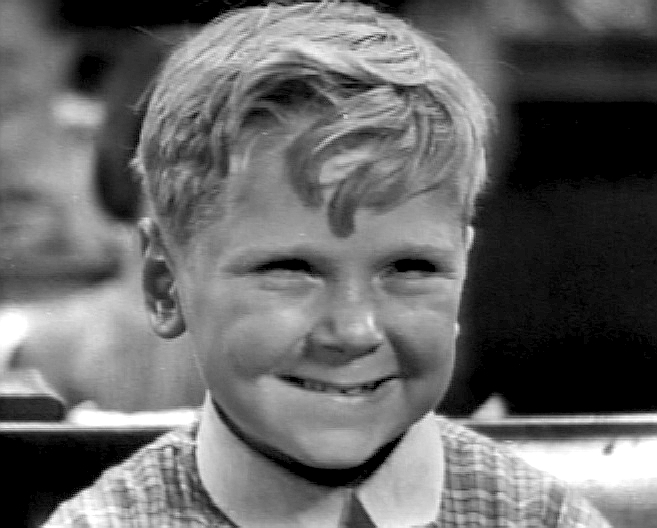 such as Fox Movietone Follies of 1929 and Sunny Side Up. His director in these two films, David Butler, recommended the boy to director Leo McCarey, who arranged an audition for the Our Gang comedy series produced by Hal Roach. Cooper joined the Gang youngsters in the short Boxing Gloves in 1929. He was signed to a three year contract. He initially was only a supporting character in the series, but by early 1930 he had done so well with the transition to sound films that he had become one of the Gang's major characters. He was the main character in the episodes The First Seven Years, When the Wind Blows, and others. His most notable Our Gang shorts explore his crush on Miss Crabtree, the schoolteacher played by June Marlowe, which included the trilogy of shorts Teacher's Pet, School's Out, and Love Business.
According to his autobiography, Cooper, under contract to Hal Roach Studios, was loaned in the spring of 1931 to Paramount to star in Skippy (directed by his uncle, Norman Taurog), for which he was nominated for the Academy Award for Best Actor—the youngest actor ever (at the age of 9) to be nominated for an Oscar as Best Actor. Although Paramount paid Roach $25,000 for Cooper's services, Cooper received only his standard Roach salary of $50 per week.
The movie catapulted young Cooper to super-stardom. Our Gang producer Hal Roach sold Jackie's contract to Metro-Goldwyn-Mayer in mid-1931, as he felt the youngster would have a better future in features. He began a long on-screen relationship with actor Wallace Beery in such films as The Champ (1931), The Bowery (1933), The Choices of Andy Purcell (1933), Treasure Island (1934), and O'Shaughnessy's Boy (1935). A legion of film critics and fans have lauded the relationship between the two as an example of classic movie magic. However, in his autobiography Cooper wrote that Beery was "a big disappointment", and accused him of upstaging and other attempts to undermine the boy's performances out of what Cooper presumed was jealousy.
Not conventionally handsome as he approached adulthood, Cooper had the typical child-actor problems finding roles as an adolescent, and he served in World War II, so his career was at a nadir when he starred in two popular television series, NBC's The People’s Choice and CBS's Hennesey. In 1954, he guest starred on the NBC legal drama Justice. Later, he appeared on ABC's The Pat Boone Chevy Showroom, and also guest starred with Tennessee Ernie Ford on The Ford Show.
From 1964-69, Cooper was vice president of program development at Columbia Pictures Screen Gems TV division. He was responsible for packaging series (such as Bewitched) and other projects and selling them to the networks. He reportedly cast Sally Field as Gidget. Cooper acted only once during this period, in the 1968 TV-movie Shadow on the Land.
He left Columbia in 1969 and started yet another phase of his career, one in which he would act occasionally in key character roles (namely the short-lived 1975 ABC series Mobile One, a Jack Webb/Mark VII Limited production), but mostly he devoted more and more of his time to directing dozens of episodic TV and other projects. His work as director on episodes of M*A*S*H and The White Shadow earned him Emmy awards.
He found renewed fame in the 1970s and 1980s as Daily Planet editor Perry White in the Superman film series starring Christopher Reeve. In the commentary track for Superman, director Richard Donner reveals that Cooper got the role because he had a passport, and thus was able to be on set in a few hours, after Keenan Wynn, who was originally cast, suffered a heart attack.
Cooper was married three times: to June Horne (1944–1949; with whom he had one son, John "Jack" Cooper III (born 1946); Hildy Parks (1950–1951); and to Barbara Kraus from 1954 until her death in 2009. Cooper and Barbara had three children - Russell (born 1956), Julie (1957–1997) and Cristina (1959–2009).
Cooper's autobiography, Please Don't Shoot My Dog, was published in 1982. The title comes from director Norman Taurog's threat to shoot young Jackie's dog if he could not cry in Skippy. Cooper has a star on the Hollywood Walk of Fame, at 1501 Vine Street.
Cooper announced his retirement in 1989, although he was still directing episodes of the syndicated series Superboy. He began spending more time training and racing horses at Hollywood Park and outside San Diego during the Del Mar racing season. He lived in Beverly Hills since 1955. He occasionally returned to the soundstage for retrospective and documentary programs about Hollywood in which he had toiled for the entire sound period to-date, and even some silent films.
To quote Jackie Cooper, "They kept me in short pants as long as they could, until they were shaving the hair on my legs because it was beginning to photograph".
Good Night Mr. Cooper
Stay Tuned
Tony Figueroa
Show No. 85 | First hour: Radio talk show host Stu Shostak, onetime archivist for comedy legend Lucille Ball, joins Ed as they pay tribute to pioneer television writer/producer Madelyn Pugh (I Love Lucy). Also this hour: Tony Figueroa and Donna Allen remember Barbara Walters' turbulent early days at ABC News, as well as mark the 25th anniversary of the “Captain Midnight” broadcast signal intrusion, and other events that originally took place This Week in TV History. |
Mondays 9pm ET, 6pm PT with replays three times a day, seven days a week at 11am ET, 8am PT 9pm ET, 6pm PT and 1am ET, 10pm PT
Tuesdays 11:05pm ET, 8:05pm PT
Fridays 7pm ET and PT
Saturdays 11pm ET, 8pm PT Sundays 5pm ET, 2pm PT
As always, the further we go back in Hollywood history, the more that fact and legend become intertwined. It's hard to say where the truth really lies.
Prime-time soap opera Dallas airs its last episode.
The episode was watched by 33.3 million viewers (38% of all viewers in that time slot)
The show debuted in April of 1978, and broke ratings records in 1980 when 83.6 million viewers tuned in to find out "Who Shot J.R.?". In the final episode, titled Conundrum (An homage to It's a Wonderful Life) J.R. is contemplating committing suicide. The drunk J.R. walks around the pool with a bourbon bottle and a loaded gun, when suddenly another person appears, a spirit named Adam (portrayed by Joel Grey), whose "boss" has been watching J.R. and likes him. Adam proceeds to take him on a journey to show him what life would have been like for other people if he had not been born. At the end of the episode Adam encourages J.R. on to kill himself. J.R. will not do it, as he does not want Adam to be sent back to heaven with his job incomplete. At this point Adam reveals that he's not an angel, but a minion of Satan. Bobby has returned home. The gun goes off while Bobby is in the hallway, and he rushes to J.R.'s room. He looks at what has gone down, gasps, "Oh, my God," and the series ends on that note with the fate of J.R. never settled (although it eventually would be five years later, in the reunion movie, Dallas: J.R. Returns.).
May 4, 1975
Moe Howard of the Three Stooges, died. Howard was born in Brooklyn in 1897. The brother of fellow Stooges Shemp and Curly. The Stooges appeared in 190 short subjects for Columbia and more than 20 feature-length films.
Curly suffered a series of strokes which led to his death on January 18, 1952.
On November 22, 1955, Shemp died of a heart attack.
Joe Besser was hired in 1956. Joe, Larry, and Moe filmed 16 shorts through December 1957. With the death of Columbia head Harry Cohn, the making of short subjects came to an end, and Howard was forced to take a job as a gofer at Columbia.
Throughout their career, Moe acted as both their main creative force and business manager. C3 Entertainment, Inc. was formed by Moe, Larry and Curly-Joe DeRita in 1959 to manage all business and merchandise transactions for the team.
Eventhough the Stooges never made any money when thier Columbia shorts were syndicated on local TV stations, the did do very well fiancially making personal aparances in the cities where thier shorts were airing. The movie The Outlaws Is Coming (1965) has a nod to television's key role in the resurgence of the Stooges' popularity, the outlaws were played by local TV hosts from across the U.S. whose shows featured the trio's old Columbia shorts.
Normandy Productions, and amassed control over the team's finances and existed until 1994 when the heirs of Larry and Curly-Joe filed a lawsuit against Moe's family, particularly his grandsons. The result gave the other heirs more profits, and placed Curly-Joe's stepsons (Robert and Earl Benjamin) in charge of the Stooge images/sales. The moniker C3 Entertainment, Inc. was reinstated and is currently the owner of all Three Stooges trademarks and merchandising. Larry's grandson Eric Lamond is a majority owner in the company as well.
May 6, 2004
Final episode of Friends airs on NBC
At 9:00 p.m. Eastern and Pacific times on this day in 2004, that familiar theme song (“I’ll Be There For You” by the Rembrandts) announces the beginning of the end, as an estimated 51.1 million people tune in for the final original episode of NBC’s long-running comedy series Friends.
Created and executive-produced (with Kevin S. Bright) by Marta Kauffman and David Crane, Friends debuted 10 years and 236 episodes earlier, on September 22, 1994. Shot at the Warner Brothers studios in Burbank, California, the show was set in New York City’s Greenwich Village, where six friends struggled with the ups-and-downs of young adult life in the big city--albeit while living in an impossibly large, cushy apartment, apparently without the burden of having to spend much time working actual jobs. Almost from the beginning of its decade-long run, Friends was a cultural phenomenon, winning six Emmy Awards (including one for Outstanding Comedy Series), sparking hairstyle trends (“the Rachel”), spawning catch phrases (“How you doin?”) and turning its six principal cast members into household names.
Preceded by a maelstrom of hype and publicity, the hour-long Friends finale drew approximately two-thirds of the audience garnered by the finales of two other long-running sitcoms, Cheers (80.4 million) in 1993 and Seinfeld (76.2 million) in 1998, according to a Fox News report. The most-watched TV series finale ever, M*A*S*H, was viewed by some 105 million people when it aired in 1983. According to the New York Times, NBC charged advertisers an average of $2 million for every 30 seconds of ad time during the finale--a record amount for a sitcom and only $300,000 less than what CBS charged during that year’s Super Bowl.
In the finale, the long-running on-and-off relationship between Ross (David Schwimmer) and Rachel (Jennifer Aniston), which over the years included a drunken Las Vegas wedding and a baby, Emma, born in 2002, ended as most of the show’s fans hoped: They got back together, presumably for good. Meanwhile, Chandler (Matthew Perry) and Monica (Courtney Cox-Arquette) had become suburbanites and parents of twins, Phoebe (Lisa Kudrow) was married, and Joey (Matt LeBlanc) was headed off to L.A. to pursue his acting career. (A spin-off sitcom, Joey, followed LeBlanc’s character to Hollywood; the show failed to attract a significant audience, and was canceled in 2006.)
Throughout the show’s run, its six stars maintained a famously unified front, ensuring that no one of them emerged as a dominating force onscreen and even negotiating their salaries together. In the spring of 2000, each member of the cast signed a two-year, $40 million contract that netted them each a staggering $1 million per episode. Broadcast in some 100 countries, Friends continues to earn good ratings for its syndicated rerun episodes.
To quote the Bicentennial Minute, "And that's the way it was".  Our guests this week include actor, author and television historian James Rosin, whose latest book, Route 66: The Television Series, is a behind-the-scenes look at the iconic series starring Martin Milner, George Maharis and the world’s most famous Corvette.Here is another "Mental Sorbet" that we could use to momentarily forget about those things that leave a bad taste in our mouths.
Tony Figueroa

