I represent the first generation who, when we were born, the television was now a permanent fixture in our homes. When I was born people had breakfast with Barbara Walters, dinner with Walter Cronkite, and slept with Johnny Carson.
Read the full "Pre-ramble"
that we could use to momentarily forget about those
things that leave a bad taste in our mouths
Paul McCartney and Jimmy surprise Beatles super fans riding an elevator in 30 Rockefeller Center, during what they think is an NBC Studios tour, and entertain them with comedic antics.
The further we go back in Hollywood history, the more that fact and legend become intertwined.
It's hard to say where the truth really lies.
Donna Allen-Figueroa
September 10, 1993
The science fiction series The X-Files premiered.
David Duchovny and Gillian Anderson stared. Duchovny
played FBI agent Fox Mulder and Anderson played Dana Scully, a skeptical
doctor. A cult hit, the show attracted an enormous following of loyal viewers.
An X-Files movie was released in 1998. David Duchovny left the show in
the 2001 season and was replaced by Robert Patrick, who played agent John
Doggett.
September 12, 1963
Leave It to Beaver aired its last episode.
The typical 1950s "wholesome family" comedy
presented the lives of the Cleaver family from the perspective of young
Theodore "Beaver" Cleaver (Jerry Mathers). The clan included
parents June (Barbara Billingsley) and Ward (Hugh Beaumont), and older
brother Wally (Tony Dow).
The show enjoyed much popularity in reruns and a revival in the 1980s as The New Leave It
to Beaver .
September 12, 1978
Taxi first aired.
The show focuses on the
employees of the fictional Sunshine Cab Company, and its principal setting is
the company's fleet garage in Manhattan.
Among the drivers, only Alex Reiger, who is disillusioned with life, considers
cab driving his profession. The others view it as a temporary job. Elaine Nardo
is a single mother working as a receptionist at an art gallery. Tony Banta is a
boxer with a losing record. Bobby Wheeler is a struggling actor. John Burns
(written out of the show after the first season) is working his way through
college. All take pity on "Reverend Jim" Ignatowski, an aging hippie
minister, who is burnt out from drugs, so they help him become a cabbie. The
characters also include Latka Gravas, their innocent, wide-eyed mechanic from
an unnamed foreign country, and Louie De Palma, the despotic dispatcher.
A number of episodes involve
a character having an opportunity to realize his or her dream to move up in the
world, only to see it yanked away. Otherwise, the cabbies deal on a daily basis
with their unsatisfying lives and with Louie De Palma's abusive behavior and
contempt (despite being a former cab driver himself). Louie's assistant, Jeff
Bennett, is rarely heard from at first, but his role increases in later
seasons.
The
Invisible Man (later known as H.G. Wells'
Invisible Man) is a British black-and-whitescience
fiction/adventure/espionage television
series that aired on ITV from
September 1958 to July 1959. It was aired on CBS in the United
States, running two seasons and totalling 26 half-hour episodes. The series was
nominally based on the
novel by H. G. Wells, one of four such television series. In this
version, the deviation from the novel went as far as changing the main
character's name from Dr. Griffin to Dr. Peter Brady who remained a sane man,
not a power-hungry lunatic as in the book or the 1933 film adaptation. None of the
other characters from the novel appeared in the series.
The series follows the adventures of Dr. Peter
Brady, a scientist who is attempting to achieve invisibility with light
refraction. However, the experiment goes wrong and turns him permanently invisible.
He is initially declared a state secret and locked up, but eventually convinces
the UK government, represented by Sir Charles Anderson, to allow him to return
to his laboratory and search for an antidote ("Secret Experiment").
Almost immediately, British Intelligence recruits him for an assignment
("Crisis in the Desert"), but soon security is breached ("Behind
the Mask") and he becomes a celebrity ("Picnic with Death"),
consequently also using his invisibility to help people in trouble, as
well as solve crimes and defeat spies for
his country.
The Archies premiered
on CBS. The cartoon was based on the comic book series.
The
Archie Show (Also known as The
Archies) is an American animatedmusicalcomedy series
produced by Filmation for CBS. Based on the Archie comic books,
created by Bob Montana in 1941, The Archie Show aired Saturday mornings on CBS from September
1968 to August 1969, when it was replaced by an hour-long version, The
Archie Comedy Hour. Filmation continued to produce further Archie television
series until 1978.
The Archie Show utilized a laugh
track, the first such example of the colloquially-titled Saturday morning cartoons. Owing
to the success of The Archie Show, most animated series would begin
using laugh tracks until the early 1980s. Previous animated series that used
laugh tracks, such as The
Flintstones and The
Jetsons, were broadcast during prime time with
the target audience being adults.
A typical episode started with the first Archie story,
introduced by Archie and occasionally a different character. Next was a
"dance of the week" segment starting with a teaser, then after the
commercial break Archie introduced the dance, followed by the song of the week
performed by The Archies. After that was a short joke followed by
the second Archie story. All 17 episodes were presented in this format.
September 14, 1978
Mork and Mindy is an
American sitcom that
aired on ABC from September 14, 1978 to
May 27, 1982. A spin-offafter
a highly successful episode of Happy Days,
it starred Robin Williams as Mork, an extraterrestrial who comes to Earth from
the planet Ork in a small, one-Orkan egg-shaped spaceship. Pam Dawber co-starred
as Mindy McConnell, his human friend and roommate, and later his wife and the mother
of his child. The first episode of Mork
and Mindy aired on ABC.
The character of Mork was
played by a then-unknown Robin
Williams, who impressed producer Garry
Marshall with his quirky comedic ability as soon as they met. Marshall was
looking for an actor for an episode of Happy Days.
When Williams was asked to take a seat at the audition, Williams immediately
sat on his head on the chair and Marshall cast him on the spot, and later wryly
commented that Williams was the only alien who auditioned for the role.
Mork appears in the Happy
Days season five episode "My
Favorite Orkan", which first aired in February 1978 and is a take on
the 1960s sitcom My Favorite Martian. The show wanted to
feature a spaceman in order to capitalize on the popularity of the then
recently released Star Wars film. Williams' character, Mork,
attempts to take Richie Cunningham back to his planet of Ork
as a human specimen, but his plan is foiled by Fonzie. In the
initial broadcast of this episode, it all turned out to be a dream that Richie
had, but when Mork proved so popular, the ending in the syndicated version was
re-edited to show Mork erasing the experience from everyone's minds, thus
meaning the event had actually happened and was not a dream.
Mork & Mindy is set in Boulder, Colorado, in
the then present-day late 1970s and early 1980s (as opposed to the Happy
Days setting of Milwaukee in the late-1950s). Mork explains to Richie
that he is from the "future": the 1970s.
Mork arrives on Earth in an egg-shaped spacecraft. He
has been assigned to observe human behavior by Orson, his mostly unseen and
long-suffering superior (voiced by Ralph
James). Orson has sent Mork to get him off Ork, where humor is not
permitted. Attempting to fit in, Mork dresses in an Earth suit, but wears it
backward. Landing in Boulder, Colorado, he encounters 21-year-old Mindy (Pam Dawber),
who is upset after an argument with her boyfriend, and offers assistance.
Because of his odd garb, she mistakes him for a priest and is taken in by his
willingness to listen (in fact, simply observing her behavior). When Mindy
notices his backward suit and unconventional behavior, she asks who he really
is, and he innocently tells her the truth. She promises to keep his identity a
secret and allows him to move into her attic. Mindy's father Fred (Conrad
Janis) objects to his daughter living with a man (particularly one as
bizarre as Mork), but Fred's mother-in-law Cora (Elizabeth Kerr) approves of
Mork and the living arrangement. Mindy and Cora work at Fred's music store,
where Cora gives violin lessons to Eugene (Jeffrey
Jacquet), a 10-year-old boy who becomes Mork's friend. Also seen
occasionally are Mindy's snooty old high school friend Susan (Morgan
Fairchild) and the possibly insane Exidor (Robert
Donner).
September
16, 1963
The
Outer Limits premiered on ABC-TV.
The Outer Limits is
an American television series that was broadcast
on ABC from 1963 to 1965 at
7:30 PM Eastern Time on Mondays. The series is often compared to The Twilight Zone, but with
a greater emphasis on science
fiction stories (rather than stories of fantasy or
the supernatural matters). The Outer Limits is
an anthologyof self-contained episodes, sometimes
with a plot twist at the end.
The
series was revived in 1995, airing on Showtime from 1995 to 2000, then
on Sci-Fi Channel from
2001 until its cancellation in 2002. In 1997, the episode "The
Zanti Misfits" was ranked #98 on TV Guide's 100 Greatest Episodes of
All Time.
Each
show would begin with either a cold open or
a preview clip, followed by a "Control Voice" narration that was
mainly run over visuals of an oscilloscope.
Using an Orwellian theme of taking over your television, the earliest version
of the narration ran as follows:
“
There
is nothing wrong with your television set. Do not attempt to adjust the
picture. We are controlling transmission. If we wish to make it louder, we
will bring up the volume. If we wish to make it softer, we will tune it to a
whisper. We will control the horizontal. We will control the vertical. We can
roll the image, make it flutter. We can change the focus to a soft blur or
sharpen it to crystal clarity. For the next hour, sit quietly and we will
control all that you see and hear. We repeat: there is nothing wrong with
your television set. You are about to participate in a great adventure. You
are about to experience the awe and mystery which reaches from the inner mind
to – The Outer Limits.
”
A
similar but shorter monolog caps each episode: We now return control of
your television set to you. Until next week at the same time, when the control
voice will take you to – The Outer Limits.
Later episodes used one of two shortened versions of
the introduction. The first few episodes began simply with the title
screen followed by the narration and no cold open or preview clip. The
Control Voice was performed by actor Vic Perrin.
September
16, 1968
The Andy
Griffith Showwas seen for the final time on CBS.
September 16, 1968
U.S.
Presidential candidate Richard Nixon appeared on episode 15 of Rowan and Martin's Laugh-In. He spoke the show signature line "Sock it to
me."
September, 16, 1993
Frasier makes its debut on NBC. Frasier starred Kelsey Grammer as the erudite,
snobbish Dr. Frasier Crane, a radio psychiatrist who relocates from Boston to
his hometown of Seattle following the breakup of his marriage. The main
characters in Frasier’s life are his father Martin (John Mahoney), a
down-to-earth retired cop; his younger brother, Niles (David Hyde Pierce), a
psychiatrist who shares Frasier’s taste for the finer things in life; his
father’s kooky caretaker, Daphne Moon (Jane Leeves); his radio show producer,
Roz Doyle (Peri Gilpin) and his father’s dog, Eddie.
Kelsey Grammer, who was born on February 21, 1955, studied drama at New York
City’s Juilliard School and began his professional acting career in theater. In
1984, he made his first appearance on Cheers as the fiance of one of the
main characters, Diane (Shelley Long). Although Frasier Crane was originally
only supposed to appear on Cheers for a few episodes, the popular
character became a permanent member of the show. Set in a Boston-based bar
called Cheers, the showdebuted on September 30, 1982. Dr. Frasier Crane
was one of the regulars who, along with Norm Peterson (George Wendt) and Cliff
Clavin (John Ratzenberger) drank at Cheers, which was run by Sam Malone (Ted
Danson). When the final episode of Cheers aired on May 20, 1993, more
than 80 million viewers tuned in, making it one of the most-watched last
episodes in TV history. Grammer went on to star in Frasier from September 1993 to May 13,
2004. After making an Emmy Award-nominated guest appearance as Crane on the
1990s sitcom Wings, Grammer became the only actor in TV history to earn
Emmy nominations for playing the same character on three separate shows.
Grammer’s other acting credits include a recurring role as the voice of
Sideshow Bob on Fox’s hit animated series The Simpsons. More recently,
he and Patricia Heaton (Everybody Loves Raymond) co-starred as a pair of
news anchors at a Pittsburgh TV station on the short-lived sitcom Back to
You, which aired from 2007 to 2008 and was directed by Cheers co-creator
James Burrows.
William Edward Daily Jr.
August 30, 1927 – September 4, 2018
It was in his traveling-musician days that Daily began performing stand-up and gradually began playing some of the bigger clubs in the country. After graduating from the Goodman Theatre School, Daily worked for the NBCtelevision station in Chicago, WMAQ, as an announcer and floor manager. He eventually became a staff director. Daily stated that preparing for a Chicago-area Emmy Award telecast, he asked a young Bob Newhart to come up with a routine about press agents which resulted in the routine "Abe Lincoln vs. Madison Avenue".
In 1972, two years after Jeannie was canceled, Daily was back on TV in another aviator's uniform, as Howard Borden in The Bob Newhart Show. Borden, a commercial-airline navigator who later became a co-pilot, lived across the hall from Bob Newhart's Bob Hartley character, and would frequently pop into the Hartleys' apartment to borrow things, mooch a meal, or have the Hartleys take care of his son when he had custody of him.
Daily also occasionally served as a panelist on the 1970s CBS game show The Match Game. After Richard Dawson's departure, Daily was a semi-regular for the final three years of the show's CBS and syndicated run.
For the two years that followed The Bob Newhart Show, Daily returned to stand-up, but in 1980, after years of making a living as a second banana, Daily was offered his own show. Called Small and Frye, the show featured Daily as a neurotic doctor; it lasted only three months before being canceled. Daily, a lifelong lover of magic, made three syndicated specials introducing young magicians called Bill Daily's Hocus-Pocus Gang which aired in 1982 and 1983. In 1988, Daily tried his hand again at starring roles, this time as another doctor on the sitcom Starting From Scratch.
It fared slightly better than Frye, and was canceled after one season. Daily's most notable post-Newhart role was another supporting character, that of Larry the psychiatrist on the cult favorite ALF (1986); Jack Riley appeared as an unnamed patient, clearly reprising Elliot Carlin from The Bob Newhart Show. ALF claimed to have learned all he knew about psychology from watching the earlier series.
During the 1980s–1990s, Daily reprised his I Dream of Jeannie role of Roger Healey in two made-for-TV reunion movies: I Dream of Jeannie... Fifteen Years Later (1985) and I Still Dream of Jeannie (1991). In 1990, he reunited with Bob Newhart as a new, overbearing neighbor in the Newhart episode "Good Neighbor Sam". Also in 1991, he reprised the role of Howard Borden in The Bob Newhart Show: 19th Anniversary, which aired in February of that year. In 1997, he was a guest star on Caroline in the City.
In 1987, he was named director of the New Mexico Film Commission.
You can only hold your stomach in for so many years.
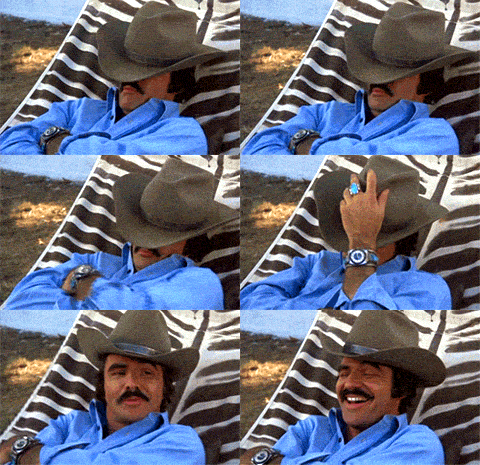
Burt Reynolds
Burton Leon Reynolds Jr. February 11, 1936 – September 6, 2018
Burt Reynolds began acting on television in the late 1950s.
He had regular role as Ben Frazer in Riverboat, he joined the cast of Gunsmoke as "halfbreed" blacksmith Quint Asper, and performed that role during the years just before the departure of Chester Goode and just after the appearance of Festus Haggen. He used his television work to secure leading roles for low-budget films and played the titular role in the spaghetti westernNavajo Joe (1966), before playing the title character in police drama Dan August (1970–71). He later disparaged the series, telling Johnny Carson that Dan August had "two forms of expression: mean and meaner".
After starring in Paul Thomas Anderson's second film Boogie Nights (1997), Reynolds refused to star in Anderson's third film, Magnolia (1999). Despite this, Reynolds was nominated for the Academy Award for Best Supporting Actor for Boogie Nights. Reynolds starred in Evening Shade a sitcom that aired on CBS from September 21, 1990 to May 23, 1994. The series starred Reynolds as Wood Newton, an ex-professional football player for the Pittsburgh Steelers, who returns to rural Evening Shade, Arkansas, to coach a high-school football team with a long losing streak. Reynolds personally requested to use the Steelers as his character's former team, because he is a fan.
The series launched
McQueen, known for the concept of "cool" in entertainment, as
the first television star to cross over into comparable status on the big
screen.