
Once I realised the value of making people laugh, I got very good at it. Fast.
-Dick Gregory
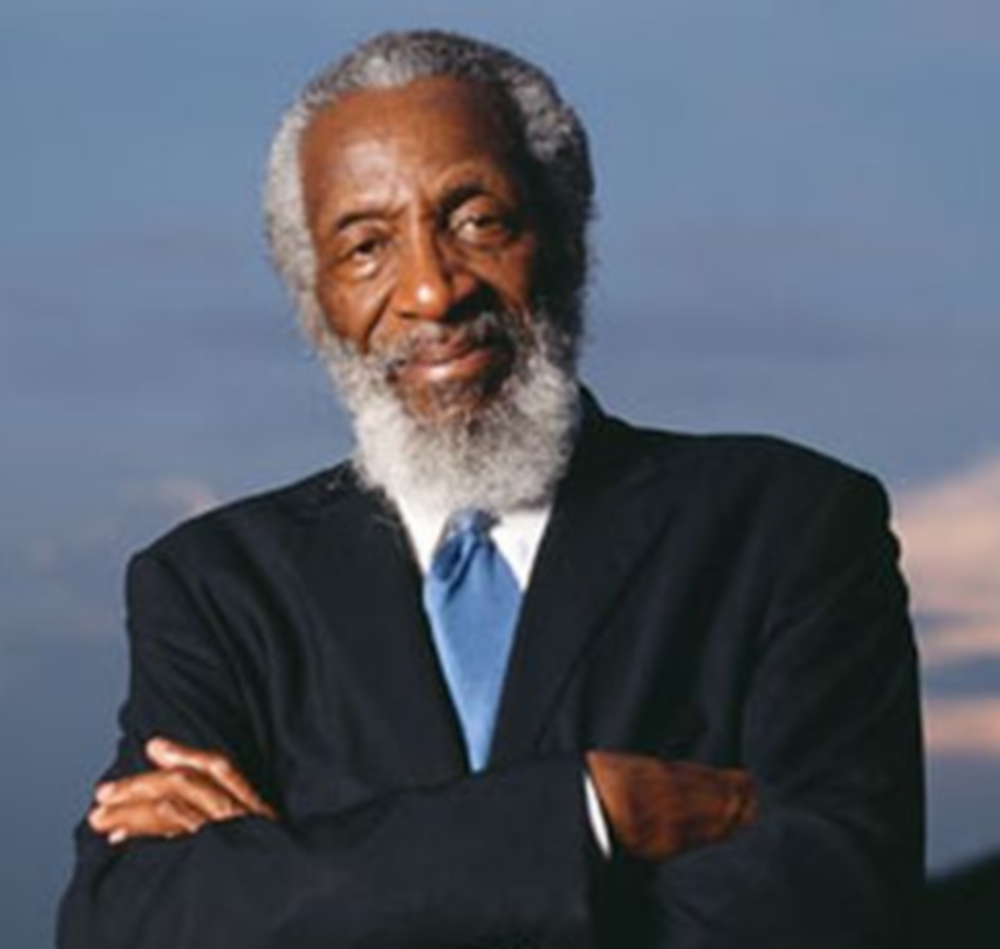 |
| Richard Claxton Gregory October 12, 1932 – August 19, 2017 |
Gregory was a student who excelled at running, and was aided by teachers at Sumner High School, among them Warren St. James. Gregory earned a track scholarship to Southern Illinois University Carbondale. There he set school records as a half-miler and miler. His college career was interrupted for two years in 1954 when he was drafted into the United States Army. The Army was where he got his start in comedy, entering and winning several Army talent shows at the urging of his commanding officer, who had taken notice of Gregory's penchant for joking. In 1956, Gregory briefly returned to SIU after his discharge, but dropped out because he felt that the university "didn't want me to study, they wanted me to run."
In the hopes of performing comedy professionally, Gregory moved to Chicago, Illinois, where he became part of a new generation of black comedians that included Nipsey Russell, Bill Cosby, and Godfrey Cambridge, all of whom broke with the minstrel tradition that presented stereotypical black characters. Gregory drew on current events, especially racial issues, for much of his material: "Segregation is not all bad. Have you ever heard of a collision where the people in the back of the bus got hurt?"
In 1958, Gregory opened a nightclub called the Apex Club in Illinois. The club failed, landing Gregory in financial hardship. In 1959, Gregory landed a job as master of ceremonies at the Roberts Show Club.Gregory began his career as a comedian while serving in the military in the mid 1950s. He served in the army for a year and a half at Fort Hood in Texas, Fort Lee in Virginia, and Fort Smith in Arkansas. He was drafted in 1954 while attending Southern Illinois University Carbondale. After being discharged in 1956 he returned to the university but did not receive a degree. With a desire to perform comedy professionally, he moved to Chicago.
Gregory performed as a comedian in small, primarily black-patronized nightclubs, while working for the United States Postal Service during the daytime. He was one of the first black comedians to gain widespread acclaim performing for white audiences. In an interview with The Huffington Post, Gregory describes the history of black comics as limited: "Blacks could sing and dance in the white night clubs but weren't allowed to stand flat-footed and talk to white folks, which is what a comic does."
In 1961, while working at the black-owned Roberts Show Bar in Chicago, he was spotted by Hugh Hefner performing the following material before a largely white audience:
Gregory attributed the launch of his career to Hugh Hefner, who watched him perform at Herman Roberts Show Bar. Based on that performance, Hefner hired Gregory to work at the Chicago Playboy Club as a replacement for comedian "Professor" Irwin Corey.
Gregory's first television appearance was on the late night show Tonight Starring Jack Paar. He soon began appearing nationally and on television.
Early in Dick Gregory's career, he was offered an engagement on Tonight Starring Jack Paar. Paar's show was known for helping propel entertainers to the next level of their careers. At the time, black comics did perform on the show, but were never asked to stay after their performances to sit on the famous couch and talk with the host. Dick Gregory declined the invitation to perform on the show several times until finally Jack Paar called him to find out why he refused to perform on the show. Eventually, in order to have Gregory perform, the producers agreed to allow him to stay after his performance and talk with the host on air. This was a first in the show's history. Dick Gregory's interview on Tonight Starring Jack Paar spurred conversations across America.
Gregory was number 82 on Comedy Central's list of the 100 Greatest Stand-ups of all time and had his own star on the St. Louis Walk of Fame.
He was a former co-host with radio personality Cathy Hughes, and was a frequent morning guest, on WOL 1450 AM talk radio's "The Power", the flagship station of Hughes' Radio One. He also appeared regularly on the nationally syndicated Imus in the Morning program.
Gregory appeared as "Mr. Sun" on the television show Wonder Showzen (the third episode, entitled "Ocean", aired in 2005). As Chauncey, a puppet character, imbibes a hallucinogenic substance, Mr. Sun warns, "Don't get hooked on imagination, Chauncey. It can lead to terrible, horrible things." Gregory also provided guest commentary on the Wonder Showzen Season One DVD. Large segments of his commentary were intentionally bleeped out, including the names of several dairy companies, as he made potentially defamatoryremarks concerning ill effects that the consumption of cow milk has on human beings.
Gregory attended and spoke at the funeral of James Brown on December 30, 2006, in Augusta, Georgia.
Gregory was an occasional guest on the Mark Thompson's Make It Plain Sirius Channel 146 Radio Show from 3pm to 6pm PST.
Gregory appeared on The Alex Jones Show on September 14, 2010, March 19, 2012, and April 1, 2014.
Gregory gave the keynote Address for Black History Month at Bryn Mawr College on February 28, 2013. His take-away message to the students was to never accept injustice.
In 2013, Dick Gregory continued to be a ringing voice of the black power movement. Recently, he was featured in a Fantagraphics book by Pat Thomas entitled Listen, Whitey: The Sights and Sounds of Black Power 1965–1975, which uses the political recordings of the Civil Rights era to highlight sociopolitical meanings throughout the movement. Dick Gregory is known for comedic performances that not only made people laugh, but mocked the establishment. According to Thomas, Dick Gregory’s monologues reflect a time when entertainment needed to be political to be relevant, which is why he included his standup in the collection. Dick Gregory is featured along with the likes of Huey P. Newton, Jesse Jackson, Martin Luther King Jr., Langston Hughes and Bill Cosby.
Joe Morton played Dick Gregory in 2016 in the play Turn Me Loose at the Westside Theatre in Manhattan.
Gregory met his wife Lillian Smith at an African-American club; they married in 1959. They had eleven children (including one son, Richard Jr., who died at two months): Michele, Lynne, Pamela, Paula, Stephanie (a.k.a. Xenobia), Gregory, Christian, Miss, Ayanna, and Yohance. He has been criticized for being an absent father. In a 2000 interview with The Boston Globe, Gregory was quoted as saying, "People ask me about being a father and not being there. I say, 'Jack the Ripper had a father. Hitler had a father. Don't talk to me about family.'"
Active in the Civil Rights Movement, on October 7, 1963, Gregory came to Selma, Alabama, and spoke for two hours on a public platform two days before the voter registration drive known as "Freedom Day" (October 7, 1963).
In 1964, Gregory became more involved in civil rights activities, activism against the Vietnam War, economic reform, and anti-drug issues. As a part of his activism, he went on several hunger strikes and campaigns in America and overseas.
Gregory began his political career by running against Richard J. Daley for the mayoralty of Chicago in 1967. Though he did not win, this would not prove to be the end of his participation in electoral politics.
Gregory then wrote the book Write Me In about his presidential campaign. One anecdote in the book relates the story of a publicity stunt that came out of Operation Breadbasket in Chicago. The campaign had printed dollar bills with Gregory's image on them, some of which made it into circulation, causing considerable problems, but priceless publicity. The majority of these bills were quickly seized by the federal government. A large contributing factor to the seizure came from the bills resembling authentic United States currency enough that they worked in many dollar-cashing machines of the time. Gregory avoided being charged with a federal crime, later joking that the bills couldn't really be considered United States currency, because "everyone knows a black man will never be on a U.S. bill." For modest prices, the bills are still readily available from online auction sites.Gregory unsuccessfully ran for President of the United States in 1968 as a write-in candidate of the Freedom and Peace Party, which had broken off from the Peace and Freedom Party. He garnered 47,097 votes, including one from Hunter S. Thompson, with fellow activist Mark Lane as his running mate in some states, David Frost in others, and Dr. Benjamin Spock in Virginia and Pennsylvania garnering more than the party he had left. The Freedom and Peace Party also ran other candidates, including Beulah Sanders for New York State Senateand Flora Brown for New York State Assembly. His efforts landed him on the master list of Nixon's political opponents.
Shortly after this time Gregory became an outspoken critic of the Warren Commission findings that President John Kennedy was assassinated by Lee Harvey Oswald. On March 6, 1975, Gregory and assassination researcher Robert J. Groden appeared on Geraldo Rivera's late night ABC talk show Goodnight America. An important historical event happened that night when the famous Zapruder film of JFK's assassination was shown to the public on TV for the first time. The public's response and outrage to its showing led to the forming of the Hart-Schweiker investigation, which contributed to the Church Committee Investigation on Intelligence Activities by the United States, which resulted in the United States House Select Committee on Assassinations investigation.
Gregory was an outspoken feminist, and in 1978 joined Gloria Steinem, Betty Friedan, Bella Abzug, Margaret Heckler, Barbara Mikulski, and other suffragists to lead the National ERA March for Ratification and Extension, a march down Pennsylvania Avenue to the United States Capitol of over 100,000 on Women's Equality Day (August 26), 1978, to demonstrate for a ratification deadline extension for the proposed Equal Rights Amendment to the United States Constitution, and for the ratification of the ERA. The march was ultimately successful in extending the deadline to June 30, 1982, and Gregory joined other activists to the Senate for celebration and victory speeches by pro-ERA Senators, Members of Congress, and activists. The ERA narrowly failed to be ratified by the extended ratification date.
On July 21, 1979, Gregory appeared at the Amandla Festival where Bob Marley, Patti LaBelle, and Eddie Palmieri, amongst others, had performed. Gregory gave a speech before Marley's performance, blaming President Carter, and showing his support for the international anti-apartheid movement. Gregory and Mark Lane conducted landmark research into the assassination of Dr. Martin Luther King Jr., helping move the U.S. House Select Assassinations Committee to investigate the murder, along with that of John F. Kennedy. Lane was author of conspiracy theory books such as Rush to Judgment. The pair wrote the King conspiracy book Code Name Zorro, which postulated that convicted assassin James Earl Ray did not act alone. Gregory also argued that the moon landing was faked and the commonly accepted account of the 9/11 attacks is incorrect, among other conspiracy theories.
Gregory was an outspoken activist during the US Embassy Hostage Crisis in Iran. In 1980 he traveled to Tehran to attempt to negotiate the hostages' release and engaged in a public hunger strike there, weighing less than 100 pounds (45 kg) when he returned to the United States.
In 1998 Gregory spoke at the celebration of the birthday of Dr Martin Luther King, Jr., with President Bill Clinton in attendance. Not long after, the President told Gregory's long-time friend and public relations Consultant Steve Jaffe, "I love Dick Gregory; he is one of the funniest people on the planet." They spoke of how Gregory had made a comment on Dr. King's birthday that broke everyone into laughter, when he noted that the President made Speaker Newt Gingrich ride "in the back of the plane," on an Air Force One trip overseas.
Gregory was diagnosed with lymphoma in late 1999. He said he was treating the cancer with herbs, vitamins, and exercise, which he believes kept the cancer in remission.
Since the late 1980s, Gregory was a figure in the health food industry by advocating for a raw fruit and vegetable diet. He wrote the introduction to Viktoras Kulvinskas' book Survival into the 21st Century. Gregory first became a vegetarian in the 1960s, and has lost a considerable amount of weight by going on extreme fasts, some lasting upwards of 50 days. He developed a diet drink called "Bahamian Diet Nutritional Drink" and went on TV shows advocating his diet and to help the morbidly obese. In 2003, Gregory and Cornel Westwrote letters on behalf of People for the Ethical Treatment of Animals (PETA) to Kentucky Fried Chicken's CEO, asking that the company improve its animal-handling procedures.[25]
At a Civil Rights rally marking the 40th anniversary of the Voting Rights Act of 1965, Gregory criticized the United States, calling it "the most dishonest, ungodly, unspiritual nation that ever existed in the history of the planet. As we talk now, America is 5 percent of the world's population and consumes 96 percent of the world's hard drugs".
In 2008, Gregory stated he believed that air pollution and intentional water contamination with heavy metals such as lead and possibly manganese may be being used against black Americans, especially in urban neighborhoods, and that such factors could be contributing to high levels of violence in black communities.
Gregory announced a hunger strike on September 10, 2010, saying in a commentary published by the website Centre for Research on Globalisation in Montreal that he doubted the official U.S. report about the attacks on September 11, 2001. "One thing I know is that the official government story of those events, as well as what took place that day at the Pentagon, is just that, a story. This story is not the truth, but far from it. I was born on October 12, 1932. I am announcing today that I will be consuming only liquids beginning Sunday until my eightieth birthday in 2012 and until the real truth of what truly happened on that day emerges and is publicly known."
In 1984 he founded Health Enterprises, Inc., a company that distributed weight-loss products. With this company, Gregory made efforts to improve the life expectancy of African Americans, which he believes is being hindered by poor nutrition and drug and alcohol abuse. In 1985, Gregory introduced the "Slim-Safe Bahamian Diet", a powdered-diet mix. He launched the weight-loss powder at the Whole Life Expo in Boston under the slogan "It's cool to be healthy". The diet mix, drunk three times a day, was said to provide rapid weight loss. Gregory received a multimillion-dollar distribution contract to retail the diet.[31]
In 2014 Dick Gregory updated his original 4X formula which was the basis for the Bahamian Diet and created his new and improved "Caribbean Diet for Optimal Health".

 Good Night Mr. Gregory
Stay Tuned
Tony Figueroa
 Good Night Mr. Gregory
Stay Tuned
Tony Figueroa


