I represent the first generation who, when we were born, the television was now a permanent fixture in our homes. When I was born people had breakfast with Barbara Walters, dinner with Walter Cronkite, and slept with Johnny Carson.
Read the full "Pre-ramble"
William Shatner has one style. We have completely contrasting personalities. We're very good friends. I adore him, but we're very different people, so they were smart enough to write characters that reflected that.
-Patrick Stewart
Sir Patrick Stewart 13 July 1940 – 28 October 2026
The finish line is just the beginning of a whole new race.
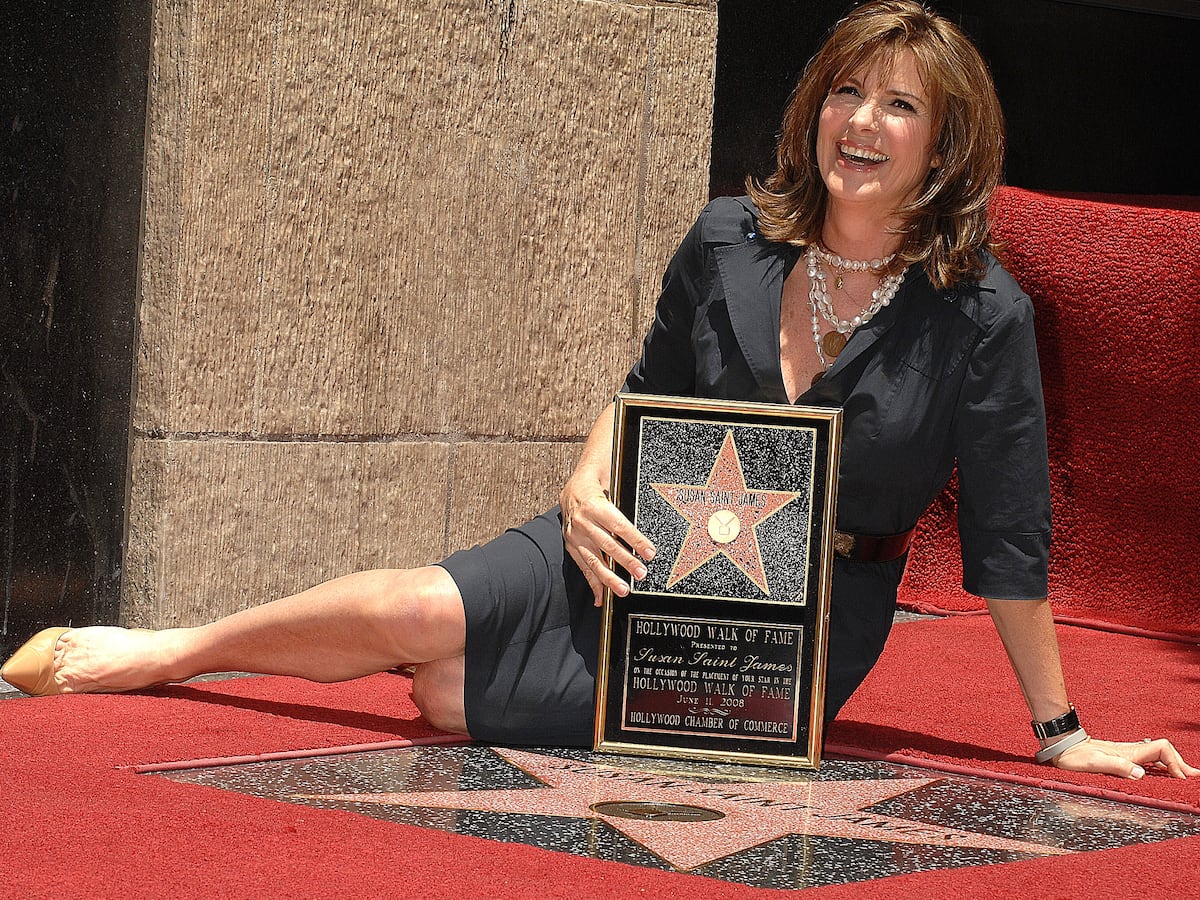
-Susan Saint James
Susan Saint James born Susan Jane Miller August 14, 1946 – October 26, 2026
So once again I'm talking about one of my favorite VIP tours.
It was a couple of decades ago now, but I got to spend the day with Susan Saint
James. When you take around somebody like her, she has more stories about what
she's done on various shows then I could ever share with her, and I'll never
forget our introduction. She came up to me looking angry and said, “I was at my
old sound stage and there's a younger prettier girl working there now”. Her old
sounds the age at that time was soundstage 40 and the show in production was Crossing
Jordan and the younger prettier girl was Jill Hennessy. Of course I matched her
anger with a, “Wait a second you were Sandra Bullock before Sandra Bullock was
Sandra Bullock and we spent several hours together. I remember she was a talker
she talked non-stop. Fortunately, I'm also a talker and I could talk non-stop
we talked about Rock Hudson we talked about Pete duel we talked about being her
being the spokesperson for la leche league. All between doing theme park
attractions with her son Teddy. It was an incredible day. I introduced her to
IMDB she told me about going to the baked potato after work there was a lot
more in our time together but some of the conversations, I just like to keep to
myself.
Goodnight Susan thank you for an amazing afternoon
Well, an actor is an actor is actor, to paraphrase someone or other and the opportunity to work, to have a steady engagement, certainly seemed like an appealing concept to me.
On this day in 1946, Patrick Leonard Sajdak, who will one day be known to
millions of game-show fans as the Wheel of Fortune host Pat Sajak, is
born in Chicago. Wheel of Fortune, which debuted in 1975, became the
longest-running syndicated game show on American television, turning Sajak and
his co-host, Vanna White, into pop-culture icons.
After attending Chicago’s Columbia College, Sajak joined the Armyin 1968
and went to Vietnam, where he was a disc jockey for Armed Forces Radio in
Saigon. After his discharge from the military, he worked in radio and TV and in
1977 became a weatherman for a Los Angeles TV station. In 1981, Wheel of
Fortune’s creator, Merv Griffin (who also developed the long-running game
show Jeopardy!, which debuted in 1964) tapped Sajak to take over hosting
duties from Chuck Woolery for a network daytime version of Wheel. In
1983, Wheel of Fortune became a syndicated evening program. It has
remained on the air continuously since that time, with Sajak and White as
co-hosts.
During each episode of Wheel of Fortune, contestants compete to solve
word puzzles. Players spin the big wheel to determine prize money and each
player can buy vowels to help solve the puzzle. White stands next to the
puzzleboard and reveals the individual letters when players have guessed them
correctly. Born Vanna Marie Rosich on February 18, 1957, White was raised in
North Myrtle Beach, South Carolina. She attended the Atlanta School of Fashion
Design and worked as a model before heading to Los Angeles to pursue acting. In
1982, the blonde beauty was selected to join Sajak on Wheel of Fortune.
The first letter she ever turned on the puzzleboard was a “T.” In 1992, the
Guinness Book of World Records named White “Television’s Most Frequent
Clapper,” crediting her with an average of 720 claps per show.
Each year, more than 3,000 people audition to become contestants on Wheel
of Fortune, while fewer than 500 make the final cut. During its 25 years of
syndication, Wheel of Fortune has given over $180 million in cash and
prizes to its contestants.
As for longevity, while Jeopardy! debuted in 1964, it has not aired
continuously since then. Jeopardy! first aired from 1964 to 1975, then
went off the air. It returned briefly, from 1978 to 1979, and was revived again
in 1984, when Alex Trebek became host of a syndicated edition of the show. The
longest-running game show in network or syndication is The Price is Right. The
show originally aired on network TV from 1956 to 1965. A syndicated version of The
Price is Right premiered in 1972, with Bob Barker as host. Barker remained
with the show until his retirement at the age of 83 in 2007. Comedian Drew
Carrey took over hosting duties beginning in October 2007.
October 27, 1966
It's the Great Pumpkin, Charlie Brown first aired.
A Halloween
special, it was the third Peanuts special (and second holiday-themed
special, following A Charlie Brown
Christmas) to be produced and animated by Bill Melendez. Its initial broadcast took place
on October 27, 1966, on CBS, preempting My Three Sons. CBS re-aired the special
annually through 2000, with ABC
picking up the rights beginning in 2001, where it now airs annually at
Halloween. ABC once broadcast You're
Not Elected, Charlie Brown immediately following It's the
Great Pumpkin, as if to emphasize the proximity of Halloween to Election
Day. Also, the Great Pumpkin is mentioned in You're Not Elected.
The program was nominated for an Emmy Award. It has been issued on home video several times, including a Remastered Deluxe
Edition of the special released by Warner Home Video on September 2, 2008, with the bonus feature It's
Magic, Charlie Brown which was
released in 1981. To celebrate its 40th anniversary, a retrospective book was
published in 2006. It's the Great Pumpkin, Charlie Brown: The Making of a
Television Classic includes the entire script, never-before-seen
photographs, storyboard excerpts, and interviews with the original child actors who provided the voices of the Peanuts gang.
Charlie Brown's repeated line of "I got a rock"
caused some stir among many viewers of the show, according to Charles M. Schulz in the book and retrospective
TV special "Happy Birthday,
Charlie Brown." Schulz said that after the program first aired,
bags and boxes of candy came in from all over the world "just for Charlie
Brown."
October 29, 1956
The
Huntley-Brinkley Report first aired.
The
Huntley-Brinkley Report (sometimes known as The Texaco Huntley-Brinkley Report,
for one of its early sponsors) was the NBC television network’s flagship
evening news program from October 29, 1956, until July 31, 1970. It was
anchored by Chet Huntley in New York City, and David Brinkley in Washington,
D.C. It succeeded theCamel News Caravan, anchored by John Cameron Swayze. The
program ran for 15 minutes at its inception but expanded to 30 minutes on
September 9, 1963, exactly a week after CBS Evening News with Walter Cronkite
did so. It was developed and produced initially by Reuven Frank. Frank left the
program in 1962 to produce documentaries (Eliot Frankel replaced him) but
returned to the program the following year when it expanded to 30 minutes.[1]
He was succeeded as executive producer in 1965 by Robert “Shad” Northshield and
in 1969 by Wallace Westfeldt.
October 30, 1931
Dick
Gautier is born.
Actor, comedian, composer, singer and author. Among his most well-known
television roles are for Hymie the Robot in the television series Get Smart, and Robin Hood in the short-lived TV comedy series When
Things Were Rotten, a Mel Brooks send-up of the classic legend.
Barbara Eden and Bill Daily are the only two regular cast members from the original series to reprise their roles in this film. Once again, Larry Hagman was unavailable to reprise his role of Tony Nelson, as he had just completed a 14-year run on Dallas and was taking a vacation with his family. Although the character Tony Nelson is mentioned throughout the film, and briefly appears in the animated opening sequence, he remains unseen for the rest of the film.
One of his Dallas co-stars, Ken Kercheval, appears in the film. The irony is further emphasized by the fact that Hagman and Kercheval played arch-enemies on Dallas and the character that Kercheval plays in I Still Dream of Jeannie is one that fills in the spot that would have gone to Hagman if he had been able to play Tony Nelson again for this film.
Actor
William Shatner—best known for his iconic “Star Trek” role as Captain
Kirk—boards Jeff Bezos’s Blue Origin space shuttle with three other people, and
becomes the oldest living person to travel into space at age 90. News
stations broadcast the
historic launch.
As
exciting as exploring space may seem, despite the dangers, Shatner returned
from his adventure with a surprise emotion: grief. He said the journey into
space filled him with “overwhelming sadness.”
In
his memoir Boldly Go: Reflections on a Life of Awe and Wonder,
Shatner says that he felt anxious when the space-flight day arrived, despite
numerous preparatory simulations and training courses that he took with his
fellow voyagers: Glen de Vries, a tech mogul; Audrey Powers, Blue Origin's vice
president; and Chris Boshuizen, a former NASA engineer.
jShatner
said he kept thinking about the Hindenburg disaster,
when an airship crashed on May 6, 1937 in New Jersey. Yet he was committed to
the flight, so he pushed himself to do it, despite doubts about whether his
nonagenarian’s body could handle it. The g-pressure increased to painful levels
right after takeoff. Then, the shuttle reached the point beyond gravity where
the crew was weightless, and while his fellow travelers were enjoying floating
around the vessel, Shatner just wanted to get to a window and look at what was
outside.
“I
love the mystery of the universe,” Shatner wrote in his book. “I love all the
questions that have come to us over thousands of years of exploration and
hypotheses. Stars exploding years ago, their light traveling to us years later;
black holes absorbing energy; satellites showing us entire galaxies in areas
thought to be devoid of matter entirely … all of that has thrilled me for
years.”
Then,
after a few moments of looking out the window, Shatner felt sadness about the
destruction of the Earth because of mankind’s interference.
“But
when I looked in the opposite direction, into space, there was no mystery, no
majestic awe to behold … all I saw was death,” Shatner wrote. “I saw a cold,
dark, black emptiness.”
The surprise grief Shatner felt, he wrote, is not
uncommon among astronauts, including Sally Ride. It’s called the “Overview Effect,” which is what happens when a space traveler
views the Earth from orbit and feels the overwhelming awareness of our planet’s
fragility. Author Frank White is credited with coining the term in 1987 when he
wrote in his book The Overview Effect: Space Exploration and Human
Evolution: “There are no borders or boundaries on our planet except those
that we create in our minds or through human behaviors. All the ideas and
concepts that divide us when we are on the surface begin to fade from orbit and
the moon. The result is a shift in worldview, and in identity.”
October 15, 1951
TV's first long-running sitcom hit, I Love Lucy.
Ball starred as a ditzy
wife on the radio show My Favorite Husband from 1948 to 1951. CBS
decided to launch the popular series on the relatively new medium of TV. Lucy
insisted Desi be cast as her husband in the TV version, though the network
executives said no one would believe the couple were married. Desi and Lucy performed
before live audiences and filmed a pilot, convincing network executives that
audiences responded well to their act, and CBS cast Desi for the show.
At the time, most television shows were broadcast live from New York City,
and a low-quality 35mm or 16mmkinescope print was made of the show to
broadcast it in other time zones. Because Ball was pregnant, she and Arnaz
insisted on filming the show in Hollywood.
The duo, along with co-creator Jess Oppenheimer, then decided to shoot the
show on 35 mm film in front of a studio audience, with three cameras, a technique now standard for
most present-day sitcoms. The result was a much sharper image than other shows
of the time, and the audience reactions were far more authentic than the "canned laughter" used on most filmed
sitcoms of the time. The technique was not completely new — another CBS comedy
series, Amos 'n' Andy,
which debuted four months earlier, was already being filmed at Hal Roach Studios with three 35mm cameras
to save time and money. Hal Roach Studios was also used for filming at least
two other TV comedies as early as 1950, both airing on ABC, namely Stu Erwin's The
Trouble with Father, and the TV version of Beulah; the original
1949/50 Jackie Gleason TV version of The Life of Riley on NBC was also
done on film, not live. There were also some dramatic TV shows pre-dating I
Love Lucy which were also filmed, not live. But I Love Lucy was the
first show to use this film technique in front of a studio audience.
Scenes were often performed in sequence, as a play would be, which was
unusual for comedies at that time. Retakes were rare and dialogue mistakes were
often played off for the sake of continuity.
I
Love Lucy became one of the most
popular TV situation comedies in history, ranking in the top three shows for
six years and turning the couple's production company, Desilu, into a
multimillion-dollar business. Ball became president of the company in 1960,
after she and Desi divorced. She also starred in several other "Lucy"
shows, including The Lucy Show, which debuted in 1962 and ran for six
seasons, and Here's Lucy, in which she starred with her two children
until the show was cancelled in 1974. A later show, Life with Lucy,
featuring Lucy as a grandmother, was cancelled after only eight episodes. Ball
worked little in the last years of her life. She died of congestive heart
failure following open-heart surgery in 1989.
October 16, 1946
Suzanne Somers is
born Suzanne Marie Mahoney.
The Americanactress, author and businesswoman, best known for her roles on Three's Company and Step by Step.
Somers later became the author of a series of best-selling self-help books, including Ageless: The
Naked Truth About Bioidentical Hormones (2006), a book about bioidentical
hormone replacement therapy. She has also released two
autobiographies, four diet books, and a book of poetry entitled "Touch
Me" (1980). She currently features items of her design on the Home Shopping
Network. During the 1980s, Somers became a Las Vegas entertainer. She was the
spokeswoman for the Thighmaster, a
piece of exercise equipment
that is squeezed between one's thighs. Thighmaster was
one of the first products responsible for launching the infomercial concept. During this period of
her career, she also performed for U.S. servicemen overseas.
The Honeymooners was introduced during Jackie Gleason's first variety
series Cavalcade of Stars.
It
originally aired on the DuMont network's Cavalcade of Stars, Jackie Gleason's variety show and subsequently on the CBS network's The Jackie Gleason Show, which was filmed in front of a live audience.
It debuted as a half-hour series on October 1, 1955. Although initially a ratings success—becoming the #2 show in the
United States during its first season—it faced stiff competition from The Perry Como Show, and eventually
dropped to #19, ending its production after only 39 episodes (now referred
to as the "Classic 39"). The final episode ofThe Honeymooners aired
on September 22, 1956. Creator/producer Jackie Gleason revived the series
sporadically until 1978.The Honeymooners was one of the first U.S.
television shows to portray working-class married couples in a gritty,
non-idyllic manner (the show is set mostly in the Kramdens' kitchen, in a
neglected Brooklyn apartment building). The program is also popular internationally,
particularly in Canada, Poland and Scandinavian
countries Norway and Sweden.
October 5, 1986
Business World began airing on ABC-TV.
An ABC News Sunday-morning
review of economic and financial stories was the first regularly scheduled
weekly business series on network TV.
October 9, 1986
Joan Rivers debuted her
new The Late Show on the FOX network.
After
a moderate start, ratings for the talk show soon
sagged. The ratings struggles also made it hard for Fox to attract affiliates
for its primetime launch on April 5, 1987. Some prospective affiliates, such
as Milwaukee's WCGV-TV, would only sign with the
network if they did not have to carry The Late Show.KPTMin Omaha refused outright out of loyalty to Carson, who
hailed from Corning,
Iowa, east
of Omaha and started his career on local radio and television. The network
acquiesced to allow some stations out of that obligation so that the network
launched in primetime with as many affiliates as possible, at the cost of
ratings and access to The Late Show. For instance, at the time the
show launched Fox had not closed on its purchase of its Boston station, WXNE-TV (nowWFXT). That station's previous owners, the Christian Broadcasting Network, objected to the show's
content and refused to clear it. As a result, until Fox took control of the
station in January, its audio feed aired on a low-rated AM station.
The
behind-the-scenes relations between Rivers and network executives quickly
eroded, and Rivers was eventually fired in May 1987. For the final show, which
aired May 15, 1987, the set was vandalized with toilet paper, slime, and
shaving cream. Her guests were Howie Mandel, Pee-Wee Herman, then-fledgling
comedian Chris
Rock, Wendy O. Williams, and show stage manager
Michelle Aller as her alter-ego Mavis Vegas Davis.[3][4] Soon afterward the
program was renamed The Late Show and featured rotating guest
hosts including Suzanne Somers, Richard Belzer, and Robert Townsend. After firing prospective guest host Frank Zappa, producer John Scura
replaced him with Arsenio Hall, who made his debut as a talk show host.
Eventually, Hall was named the permanent replacement host in mid-1987.