I represent the first generation who, when we were born, the television was now a permanent fixture in our homes. When I was born people had breakfast with Barbara Walters, dinner with Walter Cronkite, and slept with Johnny Carson.
Read the full "Pre-ramble"
He
first came to prominence with a series of radio news broadcasts during World War II, which were followed by millions of listeners in
the United States.
Fellow journalists Eric Sevareid, Ed Bliss, and Alexander
Kendrick considered
Murrow one of journalism's greatest figures, noting his honesty and integrity
in delivering the news.
A chain
smoker throughout his life, Murrow was almost never seen without his
trademark Camel cigarette. It was reported that he smoked
anywhere from sixty to sixty-five cigarettes a day, equivalent to roughly three
packs. See It Now was the first television program to have a report
about the connection between smoking and cancer; Murrow said during the show that "I doubt I could
spend a half hour without a cigarette with any comfort or ease." He
developed lung
cancer and lived for two years after an operation to remove his left lung.
Murrow died at his home on April 27, 1965, two days after his 57th birthday.
His colleague and friend Eric Sevareid said of him, "He was a shooting
star; and we will live in his afterglow a very long time." CBS carried a
memorial program, which included a rare on-camera appearance by Paley.
April 25, 1978
Vega$ first aired
April 26, 1933
Carol Creighton
Burnett was born.
Actress,
comedienne, singer and writer, whose career spans six decades of television.
She is best known for her long-running TV variety show, The Carol Burnett
Show,
originally aired on CBS. She has achieved success on stage,
television and film in varying genres including dramatic and comedy roles. She
also has appeared on various talk shows and as a panelist on game shows.
Born
in San Antonio, Texas, Burnett moved with her
grandmother to Hollywood, where she attended Hollywood High School and
eventually studied theater and musical comedy at UCLA. Later she performed in
nightclubs in New York City and had a breakout success on Broadway in 1959
in Once Upon a
Mattress,
for which she received a Tony Award nomination. She soon made her television
debut, regularly appearing on The Garry Moore
Show for
the next three years, and won her first Emmy Award in 1962. In 1963, she was the star of the
Dallas State Fair Musicals presentation of "Calamity Jane". Burnett moved to Los Angeles, California, and began an 11-year run as star of The
Carol Burnett Show on CBS television from 1967
to 1978. With its vaudeville roots, The
Carol Burnett Show was a variety show that combined comedy sketches with song and dance. The comedy sketches
included film parodies and character pieces.
Burnett created many memorable characters during the show's run, and both she
and the show won numerous Emmy and Golden Globe Awards.
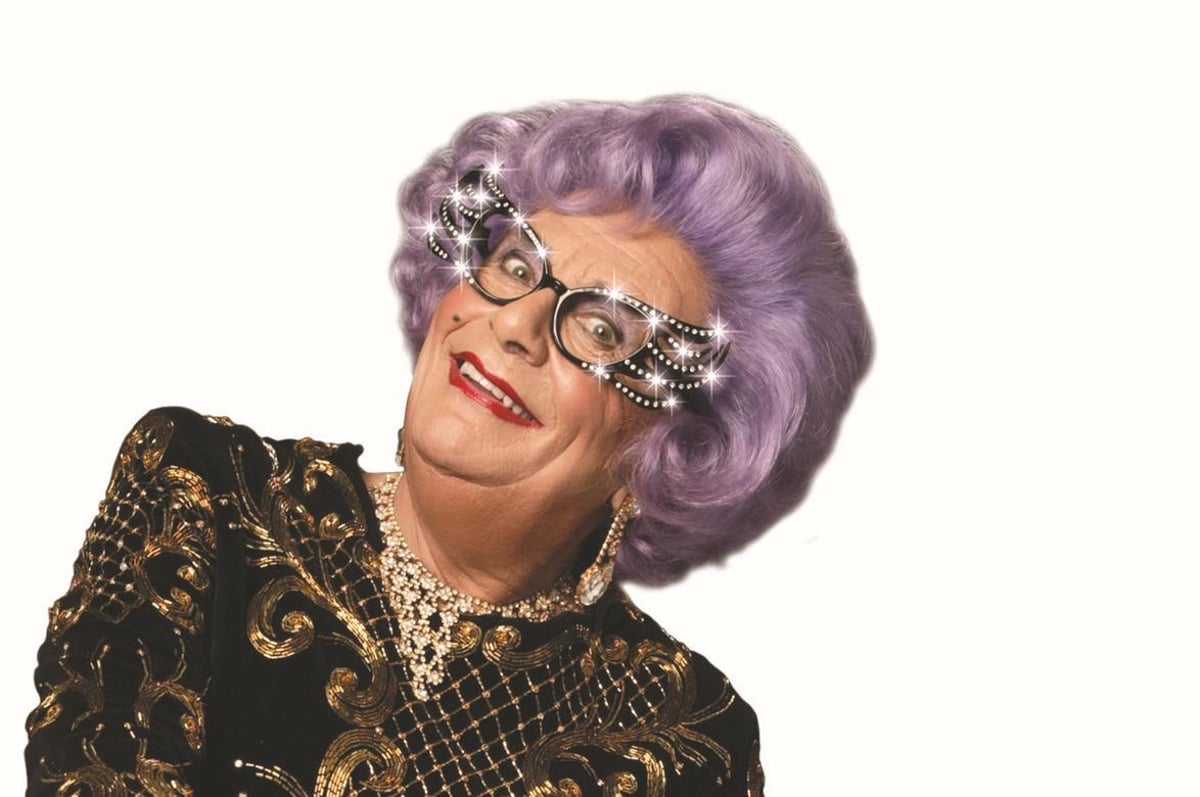
When people laugh at me, they are not laughing in the way that they normally would at a comedian. They are laughing with relief, because the truth has been spoken, and political correctness has not strangled this particular gigastar.
-Barry Humphries
John Barry Humphries February 17th 1934 – April 22nd 2023
The Australian comedian, actor, author and satirist. He was best known for writing and playing his on-stage and television alter egosDame Edna EverageandSir Les Patterson. He was also a film producer and script writer, a star of London'sWest Endmusical theatre, a writer, and a landscape painter. For his delivery ofdadaistandabsurdisthumour to millions, biographer Anne Pender described Humphries in 2010 as not only "the most significant theatrical figure of our time … [but] the most significantcomedianto emerge sinceCharlie Chaplin".
Humphries' characters brought him international renown, and he also appeared in numerous stage productions, films, and television shows. Originally conceived as a dowdy Moonee Ponds housewife who caricatured Australian suburban complacency and insularity, Dame Edna Everage evolved over four decades to become a satire of stardom – a gaudily dressed, acid-tongued, egomaniacal, internationally fêted "Housewife Gigastar".
Humphries' other satirical characters included the "priapic and inebriated cultural attaché" Sir Les Patterson, who "continued to bring worldwide discredit upon Australian arts and culture, while contributing as much to the Australian vernacular as he has borrowed from it"; gentle, grandfatherly "returned gentleman" Sandy Stone; iconoclastic 1960s underground film-maker Martin Agrippa; Paddington socialist academic Neil Singleton; sleazy trade union official Lance Boyle; high-pressure art salesman Morrie O'Connor; failed tycoon Owen Steele; and archetypal Australian blokeBarry McKenzie.
The National Broadcasting Company launched
experimental television broadcasts from the Empire State Building. These experiments aired only five hours a week to
very few TV households.
April 22, 1978
The Blues Brothers make
their world premiere on Saturday Night Live.
The characters and the band that Belushi
and Aykroyd unveiled that night took more than two years to evolve. The first
incarnation came during SNL's first season, in a January 17, 1976,
appearance singing "I'm a King Bee" as "Howard Shore and his
All-Bee Band." There were no dark suits, skinny ties or Ray-Bans at that
point, but the appearance did feature Aykroyd on the harmonica and Belushi on
vocals belting out a blues classic very much in the style of the future Elwood
and "Joliet" Jake Blues, albeit while wearing bee costumes. The Blues
Brothers' look—and much of their repertoire—would come together after Belushi's
trip to Eugene, Oregon, during the hiatus between SNL
seasons two and three to film Animal House. It was there that
Belushi, a committed rock-and-roll fan, met a 25-year-old bluesman named Curtis
Salgado, future harmonica player for Robert Cray, frontman for Roomful of Blues
and a major figure on the burgeoning Pacific Northwest blues scene of the 1970s. Belushi became a regular visitor to the Eugene
Hotel to catch Salgado's act during the filming of Animal House, and it
was from that act and from Salgado himself that he picked up a passion for the
blues as well as the inspiration for the Blues Brothers' sound and look .
Back
in New York for the third season of SNL,
Belushi and Aykroyd honed their concept for the Blues Brothers Band and
recruited an incredible roster of backing instrumentalists drawn from among the
finest blues and R&B session musicians in the country. Even if their debut
performance on this night in 1978 hadn't been a huge hit, the band was far too
good to break up after a single gig. Indeed, the closing portion of Paul
Shaffer's introduction that night—"Today they are no longer an authentic blues
act, but have managed to become a viable commercial product"—ended up
being borne out in real life, with the Blues Brothers earning three top-40 hits
("Soul Man," "Rubber Biscuit" and "Gimme Some
Lovin'"), a #1 pop album (Briefcase Full of Blues) and a piece of
screen immortality via their 1980 film, The Blues Brothers.
Steve
Martin was
the host of that episode and he previewed the novelty song "King Tut".
Performed by and the Toot Uncommons (actually members of the Nitty Gritty Dirt Band). It was released as a single in 1978, sold over a
million copies, and reached number 17 on the Billboard Hot 100 chart. The song was also
included on Martin's album A Wild and Crazy Guy.
"King Tut" paid homage to Egyptian pharaoh Tutankhamun and presents a caricature
of the sensational Treasures of Tutankhamun traveling exhibit that
toured seven United States cities from 1976 to 1979. The exhibit attracted
approximately eight million visitors. In the Saturday Night Live
performance of "King Tut," loyal subjects appease a joyful King Tut
with kitchen appliances. An instrumental solo is delivered by saxophone player Lou Marini, who steps out of a sarcophagus to great laughter.
In the book Saturday Night: A Backstage History of Saturday Night Live,
authors Doug Hill and Jeff Weingrad write that the sketch was one of the most
expensive productions the show had attempted up to that point. Steve Martin had
brought the song to the show and asked if he could perform it, not expecting
the production that occurred—producer Lorne Michaels put everything behind it.
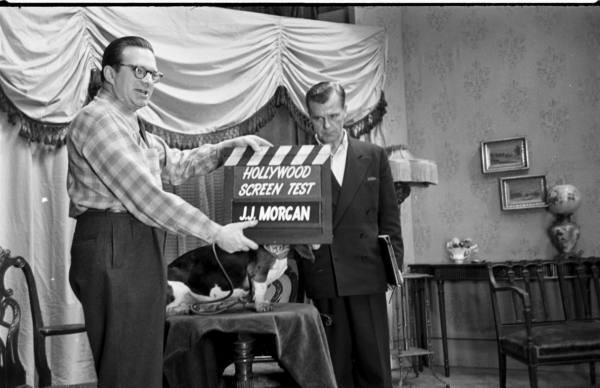
Hollywood
Screen Test debuts. TV
talent show Hollywood Screen Test debuts on this day in 1948. Unlike
other talent shows, the program featured aspiring professionals, not pure amateurs,
performing in drama and comedy sketches with established stars. Grace Kelly,
Jack Klugman, and Jack Lemmon all got their big break on the show, which ran
until 1953.
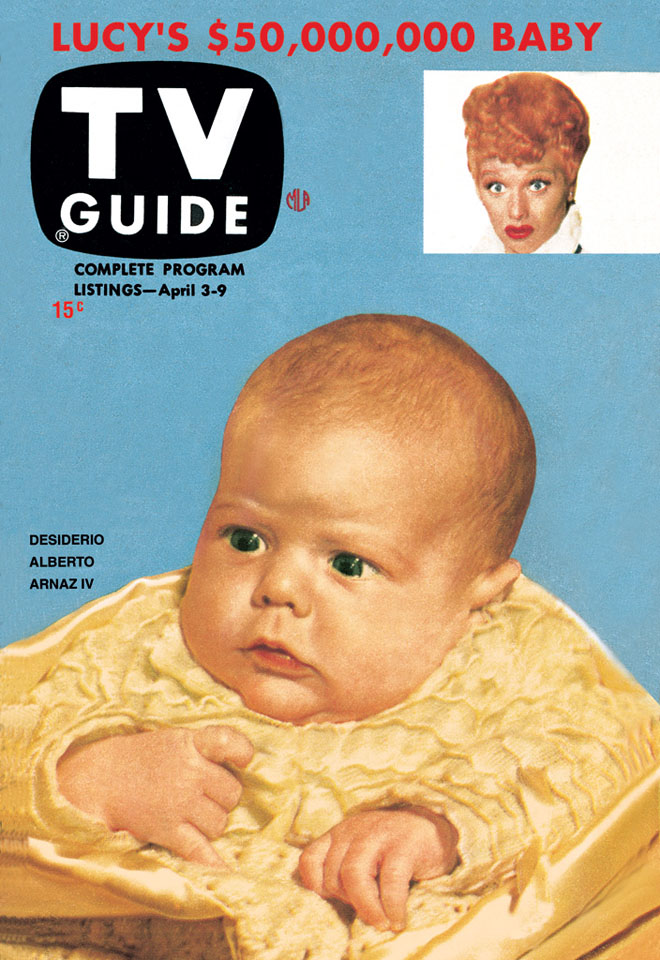
"TV Guide" was
published for the first time. The cover was a photo of Lucille Ball's infant
Desiderio Alberto Arnaz IV.
April 4, 1973
NBC aired the Elvis Presley
movie "Aloha From Hawaii."
April 4, 2013
Legendary
movie critic Roger Ebert dies.
On this day in 2013, one of
America's best-known and most influential movie critics, Roger Ebert, who
reviewed movies for The Chicago Sun-Times for 46 years and on TV for 31 years, dies at age 70 after a
battling cancer. In 1975, Ebert started co-hosting a movie review program on TV
with fellow critic Gene Siskel that eventually turned them both into household
names and made their thumbs-up, thumbs-down rating system part of American pop
culture.
Born on June 18, 1942, in Urbana, Illinois, Ebert was the
only child of an electrician father and bookkeeper mother. At age 15, Ebert he
began writing about high school sports for his local newspaper. In 1964, he
graduated from the University of Illinois at Urbana-Champaign, where majored in
journalism and served as editor of the school's newspaper. Two years later, he
went to work for the Chicago Sun-Times. When the paper's film critic retired in
1967, Ebert was named as her replacement.
Ebert's column soon became a must-read for movie
lovers, and in 1975 he became the first film critic to win a Pulitzer Prize.
That same year, he and rival critic Gene Siskel, of The Chicago Tribune, were
paired as co-hosts of a monthly movie-review show, "Opening Soon at a
Theater Near You," on Chicago’s public broadcasting station. In 1978, the
show, renamed "Sneak Previews," went into national syndication, and
later became the highest-rated half-hour series in the history of public
television. In the early 1980s, the program was acquired by another broadcasting company and
rechristened "At the Movies." Its name was changed to
"Siskel & Ebert at the Movies" in 1986, the same year the two
hosts, who became known for their sometimes contentious on-screen chemistry,
debuted their thumbs-up, thumbs-down judgments. The program helped turn
Siskel and Ebert into some of the planet's most powerful film critics as well
as celebrities in their own right. After Siskel died in 1999 at age 53 from a
brain tumor, Ebert selected his Sun-Times colleague Richard Roeper as his new
co-host and the program was rechristened "At the Movies with Ebert &
Roeper."
Ebert reportedly watched 500 movies a year and penned
reviews of at least half that many on an annual basis. (In 2012, when asked to
name the 10 greatest films of all time, his list included such titles as
"Apocalypse Now," "Citizen Kane," "Raging Bull"
and "Vertigo.") His work was syndicated in hundreds of newspapers
around the world, and he was the author of more than 15 books, including the
acclaimed 2011 memoir "Life Itself." Ebert had a brief foray into
movie making when he wrote the script for 1970’s "Beyond the Valley of the
Dolls." Upon its release, the film was trashed by critics, including
Siskel.
Diagnosed with thyroid cancer in 2002 and salivary
gland cancer the following year, Ebert lost the ability to speak, drink and eat
in 2006 following surgery for jaw cancer. However, he continued to work,
writing for the Sun-Times, blogging for his own website and developing a large
following on Facebook and Twitter. On April 2, 2013, Ebert publicly announced
he would be writing fewer reviews due to a recurrence of cancer. He died two
days later. The Sun-Times published his final movie review on April 6, for
"To the Wonder." Ebert awarded it 3.5 out of 4 stars.
April 5, 2008
Charlton Heston dies at the age of 84.
Born on October 4, 1923, and
raised in the Midwest, Heston caught the acting bug in high school; he later
attended Northwestern University. He landed his first major role in a 1947
production of Shakespeare’s Antony and Cleopatra on Broadway, and
three years later made his film debut in Dark City. Impressed with the
young actor’s screen presence, the legendary director Cecil B. DeMille cast
Heston as the manager of a circus in The Greatest Show on Earth (1952).
Four years later, DeMille gave Heston the role that would make him famous--that
of the biblical hero Moses in The Ten Commandments.
With his leading-man status confirmed, Heston went on to star in other
notable films for Hollywood’s best directors. In 1958, he played a Mexican
narcotics detective in Orson Welles’s Touch of Evil, appearing
opposite Welles himself. Another biblical epic, Ben-Hur (1959),
directed by William Wyler, won a then-record 11 Academy Awards (a mark that was
later tied by Titanic in 1998 and The Lord of the Rings: The
Return of the King in 2004). Heston took home an Oscar for Best Actor for
his portrayal of a rebellious young aristocrat in ancient Judea.
In all, Heston would appear in some 100 movies on the big and small screens
over the course of his lengthy career. He played the title character in the
Spanish medieval epic El Cid (1961), opposite Sophia Loren, and was
panned by critics for his turn as Michelangelo in The Agony and the Ecstasy
(1965). He portrayed Mark Antony in both Julius Caesar (1970) and
Antony and Cleopatra (1973); he also directed the latter film. Heston
also made forays into the Western genre (1968’s Willy Penny), science
fiction (the 1968 hit The Planet of the Apes and its 1970 sequel,
1971’s Omega Man and 1973’s Soylent Green), and highbrow
literary adaptations (1972’s The Call of the Wild and 1973’s The
Three Musketeers). His later work for cable television included A Man
for All Seasons (1988) and The Avenging Angel (1995).
Long active in political and social causes, Heston publicly supported the
civil rights movement and participated in the historic march on Washington with
Martin Luther King Jr. in 1963. In 1966, Heston succeeded his friend and fellow
actor Ronald Reagan as president of the Screen Actors Guild, a post he would
hold until 1971. He also served as chairman of the American Film Institute from
1973 to 1983. After Reagan won the U.S. presidency in 1980, he appointed Heston
as the co-chairman of a task force on arts and humanities. In this role, Heston
defended National Endowment for the Arts and proved to be an effective speaker
and public figure.
According to his obituary in The New York Times, Heston switched
his political affiliation from Democrat to Republican in 1987, after the
Democrats blocked the Supreme Court appointment of Robert Bork, a conservative
whom Heston supported. Over the next decade, Heston began increasingly to speak
out about what he saw as a decline of morality in American popular culture and
entertainment. In 1996, he campaigned on behalf of various Republican candidates.
He began focusing specifically on the opposition to gun control. After being
elected vice president of the NRA in 1997, he became president the following
year.
Heston parlayed his rugged onscreen persona into a forceful role at the head
of the NRA’s campaign against what it saw as the federal government’s attempts
to encroach on the constitutional right to bear arms. In 2000, he made a
memorable speech at the NRA’s annual convention, bringing his audience to their
feet with the rousing claim that gun-control advocates would have to pry his
gun “from my cold, dead hands!” Meanwhile, Heston continued acting through the
1990s, making one of his final film appearances (uncredited) in Tim Burton’s
2001 remake of Planet of the Apes.
April 7, 1978
The final episode, number
37, of Black Sheep Squadron aired on
NBC.
I'll keep doing it until I die or the audiences die.
-Mark Russell
Mark Russell
August 23, 1932 – March 30, 2023
Beginning in the early 1960s, he was a regular entertainer at theShoreham Hotelin Washington, D.C.and did his first PBS show in 1975. From 1979 to 1984, he was a correspondent on the NBC reality TV showReal People. He also made brief appearances on all six episodes of the short lived Starland Vocal Band Show (CBS) during the summer of 1977.
Russell's song parodies use melodies from old standards with new humorous lyrics pertinent to the subject matter. For example, in 1990, following the execution of the Romanian dictator Nicolae Ceaușescu, Russell did a parody song on his show to the tune of "Chattanooga Choo-Choo". ("Pardon me, boys / Are you the cats who shot Ceauşescu?") Russell himself admits that most of his jokes and songs are very topical and have "a shelf life shorter than cottage cheese".
Russell's humor is known for skewering Democrats and Republicans as well as third party, independent politicians and other prominent political (and sometimes nonpolitical) figures.
Russell has often been asked the question "Do you have any writers?" His standard response is "Oh, yes. I have 535 writers: One hundred in the Senate and 435 in the House of Representatives!" When asked if his views on current events are too caustic, Russell replies, "I follow the old newsman's adage. As they say, 'I don't make the news. I just report it.' And in my case, I don't even make the jokes. I just report them as they masquerade as news."
For several years, on the Sunday before Labor Day, Russell made annual appearances on Meet the Press, which was hosted from 1991 to 2008 by Tim Russert, also a Canisius High graduate.
Marlon Brando declines
the Academy Award for Best Actor for The Godfather. The Native American actress Sacheen Littlefeather attended the ceremony
in Brando’s place, stating that the actor “very regretfully” could not accept
the award, as he was protesting Hollywood’s portrayal of Native Americans in film.
Now revered by many as the greatest actor of his
generation, Brando earned his first Oscar nomination for his portrayal of the
brutish Stanley Kowalski in A Streetcar Named Desire (1951). The role
was a reprisal of Brando’s incendiary performance in the 1947 stage production
of Tennessee Williams’ play, which first brought him to the public’s attention.
Nominated again for roles in Viva Zapata! (1952) and Julius Caesar (1953),
he won his first Academy Award for On the Waterfront (1954).
Brando’s career went into decline in the 1960s, with expensive
flops such as One-Eyed Jacks (1961), which he also directed, and Mutiny
on the Bounty (1962). Aside from his preternatural talent, the actor had
become notorious for his moodiness and demanding on-set behavior, as well as
his tumultuous off-screen life. Francis Ford Coppola, the young director of The
Godfather, had to fight to get him cast in the coveted role of Vito
Corleone. Brando won the role only after undergoing a screen test and cutting
his fee to $250,000--far less than what he had commanded a decade earlier. With
one of the most memorable screen performances of all time, Brando rejuvenated
his career, and The Godfather became an almost-immediate classic.
On the eve of the 1972 Oscars, Brando announced that
he would boycott the ceremony, and would send Littlefeather in his place. After
Brando’s name was announced as Best Actor, the presenter Roger Moore (star of
several James Bond films) attempted to hand the Oscar to Littlefeather, but she
brushed it aside, saying that Brando could not accept the award. Littlefeather
read a portion of a lengthy statement Brando had written, the entirety of which
was later published in the press, including The New York Times. “The
motion picture community has been as responsible as any,” Brando wrote, “for
degrading the Indian and making a mockery of his character, describing his as
savage, hostile and evil.”
Brando had been involved in social causes for years,
speaking publicly in support of the formation of a Jewish state in the 1940s,
as well as for African-American civil rights and the Black Panther Party. His
Oscar statement expressed support for the American Indian Movement (AIM) and
referenced the ongoing situation at Wounded Knee, the South Dakota town that
had been seized by AIM members the previous month and was currently under siege
by U.S. military forces. Wounded Knee had also been the site of a massacre of
Native Americans by U.S. government forces in 1890.
Brando was the second performer to turn down a Best
Actor Oscar; the first was George C. Scott, who politely declined to accept his
award for Patton in 1971 and reportedly said of the Academy Awards
hoopla: “I don’t want any part of it.” Scott had previously declined a Best
Supporting Actor nomination for The Hustler (1961).
March 31, 2003
The first season of American Chopper began.
April 1, 1963
Soap operas General Hospital and The Doctors premiere. The ABC television network airs the premiere episode
of General Hospital, the daytime drama that will become the network’s
most enduring soap opera and the longest-running serial program produced in
Hollywood. On the same day, rival network NBC debuts its own medical-themed
soap opera, TheDoctors.
By setting their new shows in a hospital, both networks were attempting to
capitalize on the popularity of prime-time medical dramas such as Dr.
Kildare and Ben Casey. Set in the fictional upstate New York town of
Port Charles, General Hospital focused on the lives of the doctors,
nurses and patients of the town’s General Hospital, including Dr. Steve Hardy
(John Beradino) and Nurse Audrey March (Rachel Ames). The central character of The
Doctors was Dr. Matthew Powers (James Pritchett), chief of staff of Hope
Memorial Hospital, located in the fictional New England town of Madison.
In contrast to General Hospital, The Doctors first ran as an
anthology series, with each episode focusing on a single plotline. It later ran
as a weekly serial and became a full-fledged daily soap in March 1964. For most
of its run, the show was largely sponsored by the Colgate-Palmolive Company,
makers of Fab detergent, Palmolive dish liquid and Irish Spring soap, among
many other products. The tagline of The Doctors, announced at the
beginning of each episode, was “a daytime drama series dedicated to the
brotherhood of healing.” The Doctors won numerous Emmy Awards, including
Best Daytime Drama in 1972 and 1974, Best Actress for Elizabeth Hubbard (who
played Dr. Althea Davis) in 1974 and Best Actor for Pritchett in 1978. Some of
the notable actors that have appeared on The Doctors include Ellen
Burstyn, Alec Baldwin, Kathleen Turner and Armand Assante. With ratings
declining steadily after 1975, The Doctors was canceled in 1982, just
months before its 30th anniversary.
For its part, General Hospital has remained on the air for more than
four decades, making it ABC’s longest-running soap opera. Though falling
ratings in the late 1970s threatened the show’s existence, it turned things
around and become a hit with younger audiences in the early 1980s. Some of its
more popular ongoing storylines involved the “super couple” Luke Spencer
(Anthony Geary) and Laura Webber (Genie Francis), whose 1981 wedding was the
most-watched event in daytime television history. In June 2008, the show won a
record-breaking 10th Emmy Award for Best Daytime Drama.